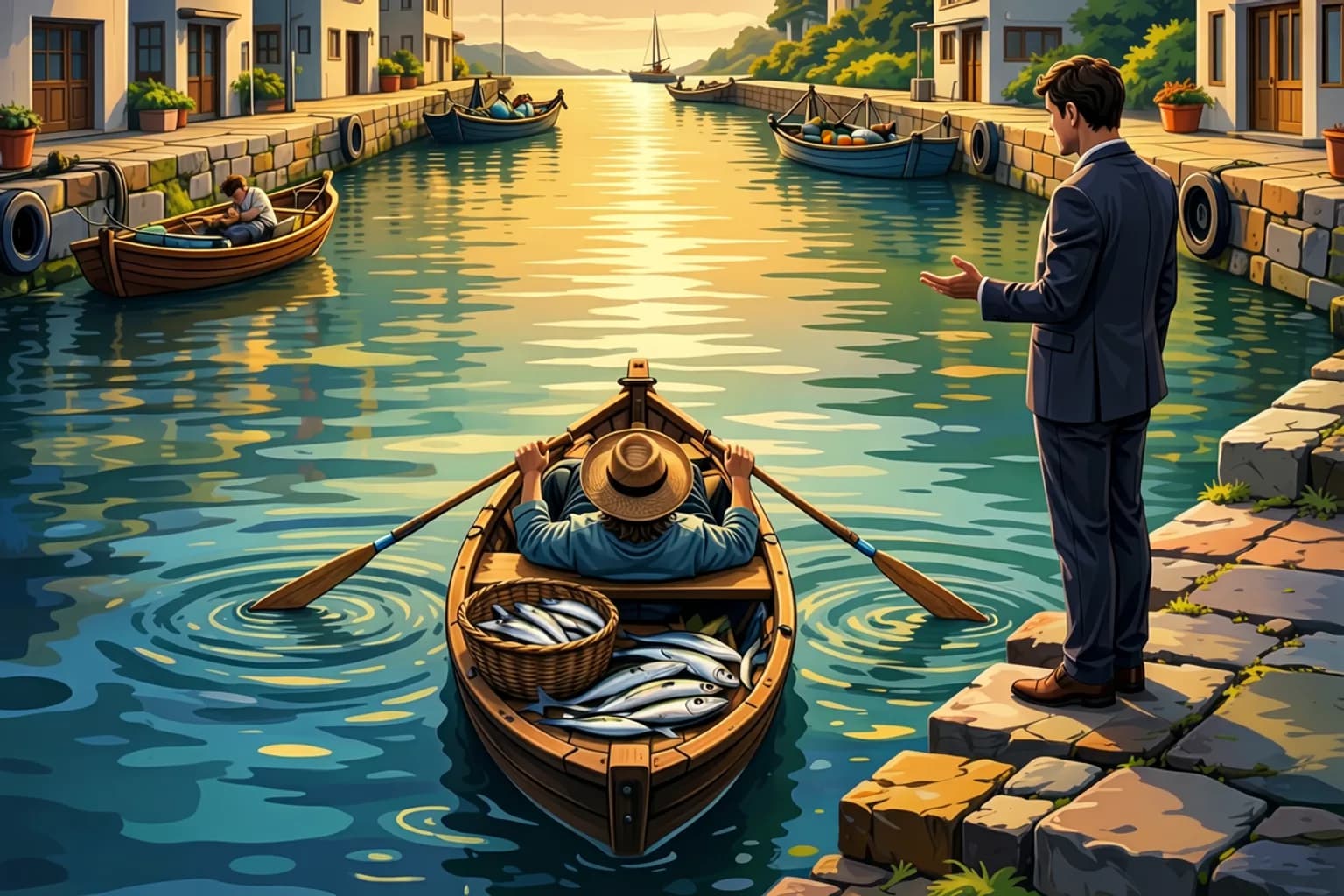
A businessman on holiday walked down to a small harbour in the middle of the morning and found a fisherman lying in his boat in the sun, doing nothing at all, with a few good fish in a basket beside him.
The businessman asked how long it had taken to catch them.
Not long, said the fisherman.
Then why not stay out and catch more?
Because this is enough, the fisherman said. This feeds my family today and there is some left to sell.
The businessman asked what he did with the rest of the day.
I sleep late, said the fisherman. I fish a little. I play with my children. In the afternoon I sleep again, and in the evening I walk into the village and see my friends, and we eat and we play music and we talk until it is late. It is a full day.
The businessman said he could help him. He explained that he had spent years studying exactly this kind of problem.
You should stay out longer and catch more fish. With the extra money you buy a bigger boat. The bigger boat pays for a second boat, then a third, and before long you have a fleet. Then you stop selling to the middleman and sell directly to the processor, and then you build your own processing plant, and you control the product from the water to the shelf. At that point you leave this village, because you will need to be in the city to run it properly, and after that a capital, because that is where the finance is.
The fisherman asked how long all of this would take. Fifteen years, the businessman said, maybe twenty.
And then what?
Then, said the businessman, comes the best part. You take the company public and you sell your shares and you become very rich. Millions.
Millions, said the fisherman. And then what?
Then you retire. You move to a small village by the coast. You sleep late, you fish a little, you play with your children, you take a rest in the afternoon, and in the evening you walk down and see your friends and drink some wine and play a little music.
The Lesson of the Fisherman and the Businessman
Write down the end of the plan. Not the next step. The end. A surprising number of ambitions dissolve the moment somebody says the final state out loud, because it turns out to be a description of a Tuesday you could have had this year.
Some plans are the only route and some are a detour. The story is not saying build nothing. It is saying find out which one you are on, because they look identical from the inside and only one of them requires twenty years.
Enough is a decision, not an amount. The fisherman had not been given anything the businessman lacked. He had simply already decided what enough meant, which is the one step of the plan nobody schedules.
Where this actually comes from
The version everybody shares is set in Mexico and features a Harvard MBA, and it is an American adaptation.
The original is German. Heinrich Böll wrote it in 1963 for radio, under a title that translates roughly as an anecdote concerning the lowering of productivity. It is set on a European coast, the fisherman is dozing in a harbour, and the tourist is a photographer whose camera clicking wakes him up.
Böll was writing satire aimed at a specific thing, which was the work ethic of postwar Germany during its economic miracle, and the ending is sharper than the one we now tell. His tourist does not get a lesson and go away enlightened. He walks off filled with a particular emotion, and Böll names it precisely: no trace of pity, only a little envy.
That is a better ending, and it is the one most people never hear. The businessman is not converted. He simply leaves knowing that the man in the boat has something, and goes back to work anyway, which is what nearly everyone who shares this story also does.
The rest is for seekers
Keep reading free. Log in and every article on Reality Awake opens for you.