A peasant named Pahom was listening to his wife argue with her sister about which was the better life, the town or the land, and he was only half attending, and at some point he said the thing out loud that he had been thinking for years.
If I had land enough, he said, I would not fear the devil himself.
Something in the room heard him.
He did well after that. He bought a plot and it was good and he worked it, and then the plot next to it, and each time the new land was better than the last and each time it stopped being enough within a season. He fell out with neighbours over boundaries. He moved his family twice, further out each time, chasing bigger and cheaper.
Then he heard about the Bashkirs, far out on the steppe, who had more land than they could count and who sold it strangely.
Their price was a thousand roubles for a day.
Not for an acre. For a day. You paid, and at sunrise you started walking from an agreed spot, and everything you walked around before sunset was yours. You marked your line with a spade as you went. There was one condition, and they said it plainly: if you were not back at the starting point by the time the sun went down, you lost the money and you got nothing.
He did not sleep that night. He lay working out how much a man can walk in a day, and every calculation he made was of the ground he could gain, and none of them were about the walk back.
At sunrise he set off fast. The land was better than he expected, which was the problem. Every time he decided on a corner, there was a stretch just beyond it too good to leave outside the line, so he pushed on and made the corner later. He did this three times.
By afternoon he was a very long way out and the shape he had drawn was enormous and badly made, and the sun had started down.
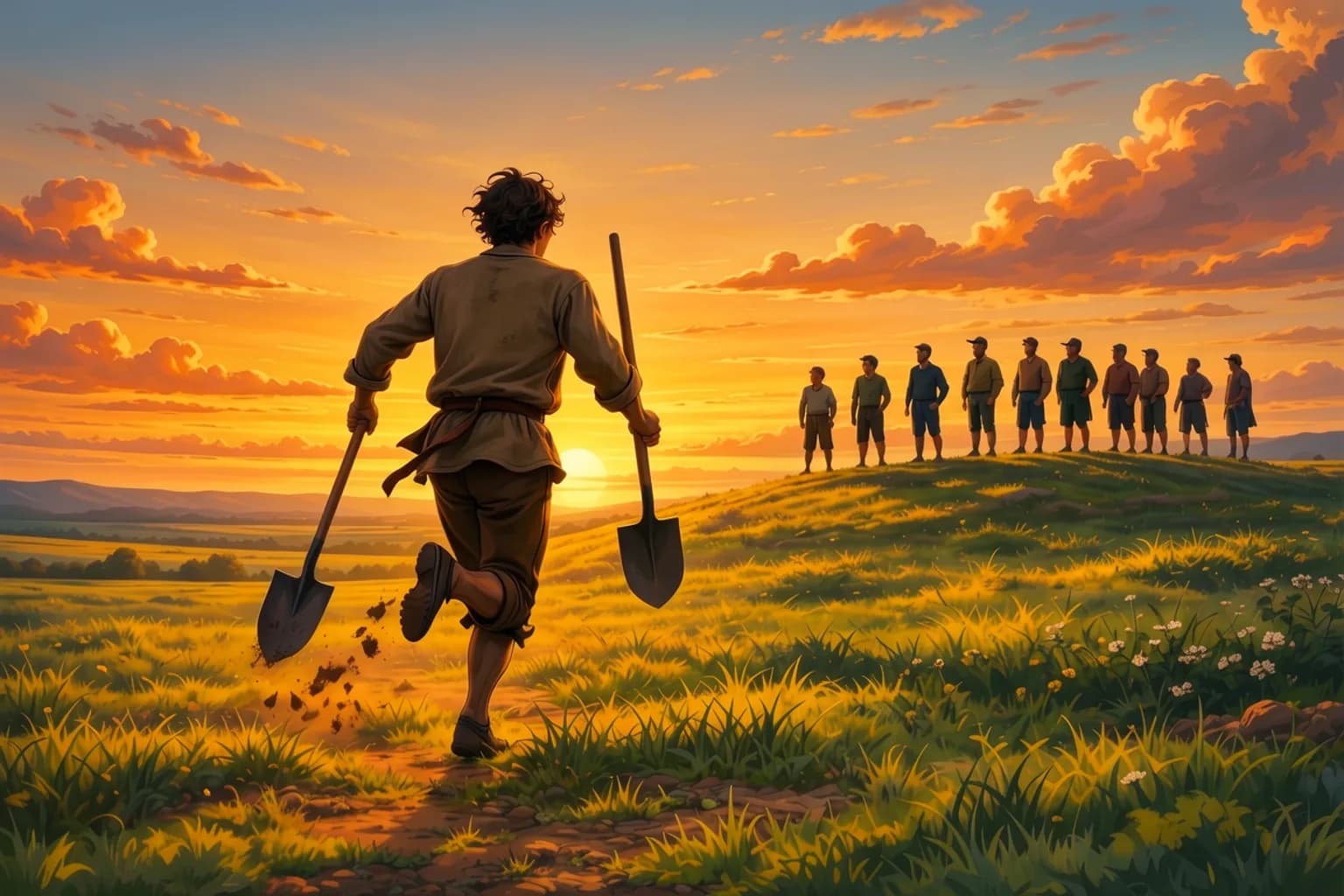
He began to run. He threw away his coat and his boots and kept the spade because he needed it. His chest was burning and he could see the hillock where the Bashkirs were sitting, small and far, and the sun was going into the horizon behind it.
He got there. In the last of the light, with the Bashkirs shouting and clapping at the size of what he had taken, he reached the starting point and fell forward onto it, and blood came out of his mouth, and he was dead.
His servant took the spade and dug him a grave. Six feet from head to heel.
That was how much land he needed.
The Lesson of How Much Land Does a Man Need
The trap was not the offer, it was the absence of a target. He was given a genuinely generous deal and no upper limit, and a man with no number in his head cannot be satisfied by any amount. Decide the size of the plot before you start walking.
Every extension was reasonable. He never once made a mad decision. Each corner he pushed past was worth pushing past, on its own, in the moment. Ruin does not usually arrive as a single bad choice, it arrives as a run of good ones with no stopping rule.
Count the return journey. Whatever you are acquiring, some part of the cost is getting back to your life afterwards, and that is the part nobody includes in the calculation at sunrise.
Where this actually comes from
This is Tolstoy, written in 1886, and it is one of the few stories in this series with a known author and a fixed text. James Joyce thought it was the finest story world literature had produced.
Two things usually go missing.
The frame is the first. Most retellings drop the opening, in which the devil overhears Pahom's boast about not fearing him and decides to give him exactly what he asked for. That changes the story. Without it, this is a fable about a greedy man who overreached. With it, it is about a wish granted precisely as worded, by something that was listening, and the horror is in the accuracy rather than the punishment.
The second is that Tolstoy was not inventing the steppe. Russian settlers really were buying Bashkir land on the frontier at the time, often on terms the sellers did not fully control, and readers in 1886 would have understood the bargain as something closer to reportage than fantasy.
He wrote it in the years after his own religious crisis, when he had begun giving away what he owned and fighting with his family about it, so the question in the title was not rhetorical for him. He was asking it about himself.
The rest is for seekers
Keep reading free. Log in and every article on Reality Awake opens for you.