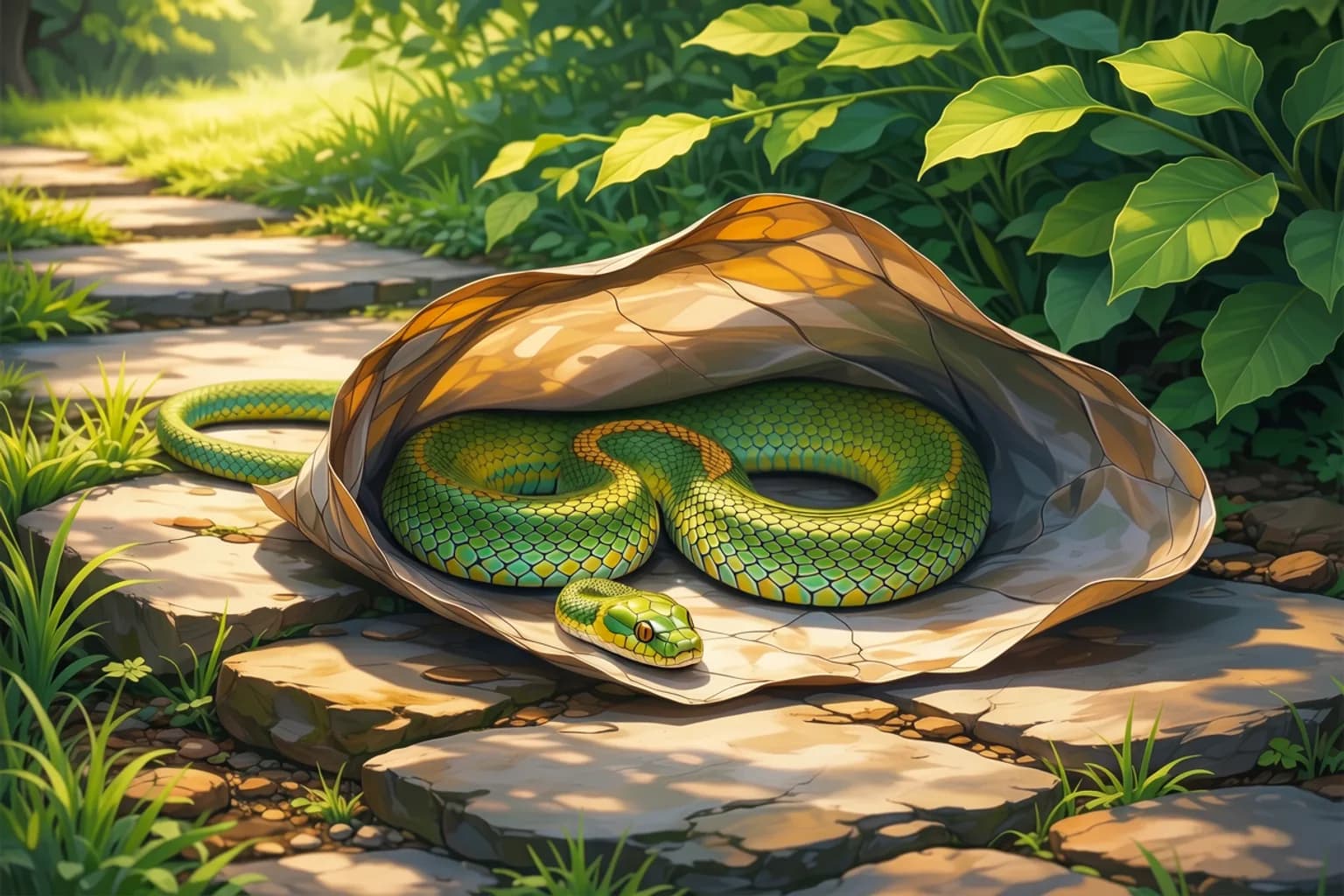
Few dreams send people to their phones at sunrise faster than a snake. The image is ancient and the unease is older still; humans have been dreaming of serpents for as long as we have records of dreams at all, and nearly every tradition on earth has had something to say about it.
My grandmother kept a small notebook of her dreams beside the I Ching on her desk, and snakes appear in it more than any other animal. Hers was a Chinese reading: snakes could be fortune arriving, or a person of cunning circling close. When I dreamt of one as a child she would ask two questions before any interpretation: what was the snake doing, and how did you feel? I have never found a better starting method.
What the Traditions Say
The snake is what scholars call an overdetermined symbol: it has carried too many meanings, in too many cultures, for any single one to be final.
- Transformation. The snake sheds its skin whole. Across cultures it stands for renewal, the old self left behind in the grass.
- Healing. A serpent coils around the staff of medicine to this day, an inheritance from Greek temples of healing.
- Hidden knowledge. From Eden to the kundalini of the yogis, the snake guards or offers what is not yet known.
- Danger close to home. And yes, sometimes the snake is threat: something quiet, low to the ground, and nearer than you noticed.
The breadth is the point. A snake dream rarely answers a question. It hands you one.
What the Dream Asks
When a snake visits your sleep, the details are the message. A snake calmly present is a different dream from one that strikes; a shed skin is a different dream from a bite. When I sit with my own journal, I work through three questions. Where was the snake, in whose house, on whose path? What was it doing, and did it see me? And the question my grandmother always saved for last, because it matters most: what did I feel, fear, awe, calm, or recognition?
Nine times out of ten, the feeling in the dream points straight at something in waking life wearing the same emotional clothes. The snake is the costume. The feeling is the actor.
Do not ask what the snake means. Ask what, in your waking life, currently moves the way that snake moved.
Where This Really Comes From
Honesty, as always in this column. There is no evidence that dreams are coded messages with a fixed dictionary, where snake equals betrayal and water equals money. The modern dream dictionary is a publishing tradition, not a science. What research does support is humbler and more interesting: dreams reuse the day's emotional residue, and they speak in images rather than sentences. The snake recurs across humanity likely because our primate ancestors spent millions of years needing to notice serpents quickly; the image is burned deep into the equipment we dream with.
So the snake in your sleep is probably not a prophecy. It is your oldest alarm system borrowing its most vivid costume to flag something that has your nervous system's attention. That is not less meaningful than prophecy. It is meaning with your own name on it.
A Practice for the Morning After
Write the dream down before it fades, feelings first. Then finish one sentence: "Something in my life right now feels like that snake because..." Do not force it. If nothing comes, let the dream rest; the good ones return. If something comes, you have just done what dreamers in temples and farmhouses have done for five thousand years: let the night show you what the day was too busy to see.