Of all the gods I have spent my life reading about, none is more misread by outsiders than Shiva. The title "the Destroyer" does him no favours in translation. Western readers hear it and imagine something demonic, when the tradition means almost the opposite: Shiva destroys the way a forest fire destroys, the way winter destroys, clearing what is finished so that something new can live.
I first met Shiva properly in a small museum in Delhi, standing before a bronze Nataraja so old the dancing god had gone green. The card on the wall ran out of room trying to explain everything happening in that one figure. Most gods need a book. Shiva needs a library.
The Third of the Trimurti
In the great trinity of Hindu thought, Brahma creates, Vishnu preserves, and Shiva dissolves. The three are not rivals but phases of one endless cycle, the same cycle you can watch in any garden: things arise, things ripen, things break down and feed what comes next. Shiva presides over the breaking down, which makes him not the enemy of life but its precondition.
This is why his worshippers, and there are hundreds of millions, do not approach him with dread. They approach him with the particular love people reserve for the one who tells them the truth: that nothing lasts, and that this is not the bad news it first appears to be.
The God of Contradictions
Shiva is deliberately impossible to pin down, and the tradition delights in his contradictions:
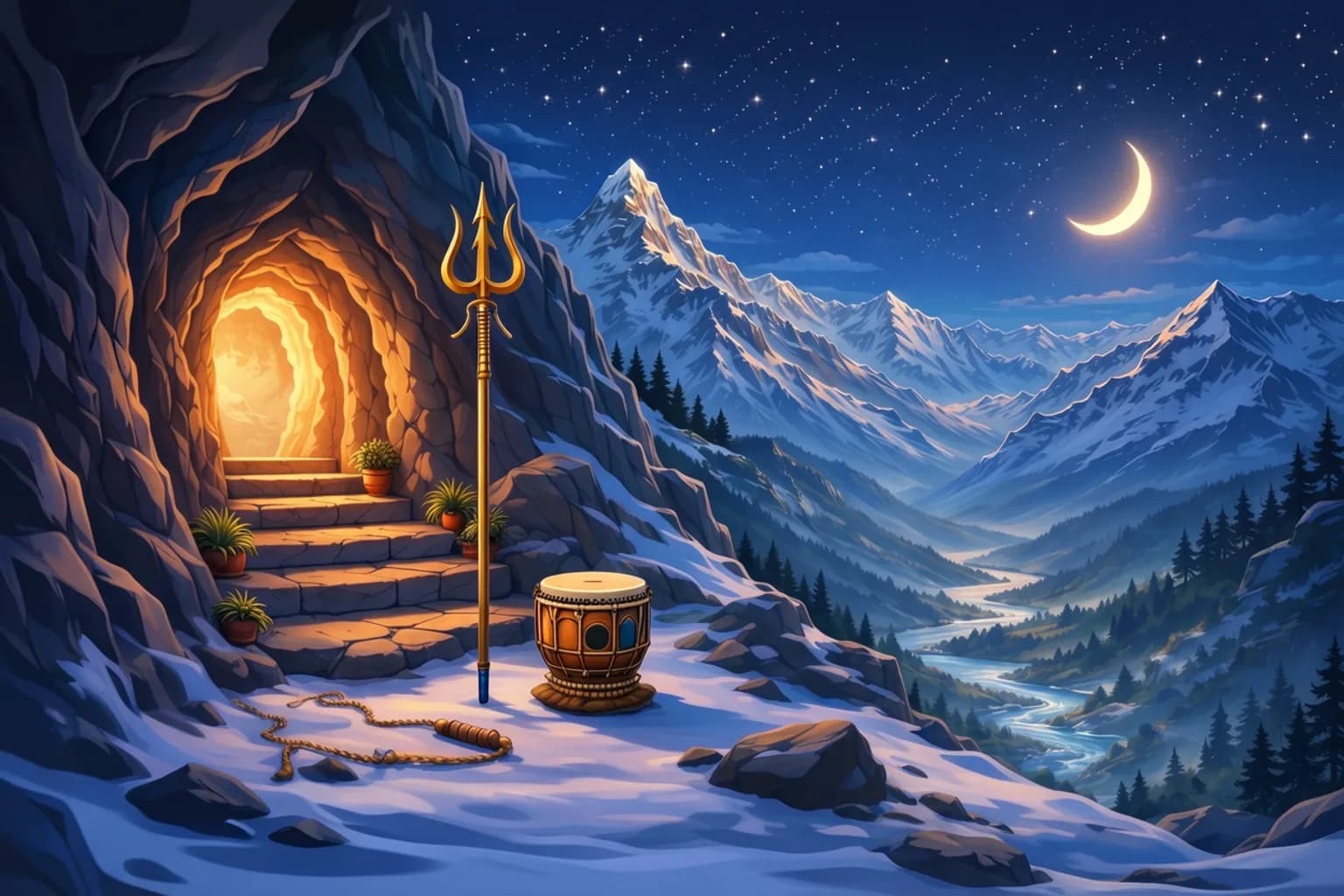
- He is the perfect ascetic, meditating motionless on Mount Kailash, and also the passionate husband of Parvati.
- He is the wild dancer whose tandava shakes the universe apart, and the still yogi whose calm holds it together.
- He wears a garland of skulls and carries the crescent moon, death and beauty on the same body.
- He drank the poison that surfaced when the oceans were churned, holding it in his throat to save everyone else, which is why his throat is blue.
Shiva is what the sacred looks like when it refuses to be respectable: wild, ash-smeared, and more compassionate than all the polished gods combined.
The contradictions are the teaching. A god who contains opposites tells his worshippers that they may contain opposites too, that the wild and the disciplined, the householder and the hermit, can live in one person.
The Story Behind the Stories
Historically, Shiva appears to be one of the oldest continuously worshipped deities on earth. Scholars trace his lineage back toward Rudra, the howling storm god of the Vedas, and some see an even older ancestor in a horned figure seated in a yogic posture on seals from the Indus Valley, four and a half thousand years ago. Whatever the exact line of descent, the god you meet in a temple today carries layers of history the way his hair carries the Ganga: an entire river of older traditions, caught and channelled.
That, to me, is the real wonder of Shiva. Gods, like people, have biographies. His is among the longest still being written.
What Shiva Teaches
Strip away the iconography and Shiva offers a teaching anyone can use, whatever they believe. Endings are not failures. The things in your life that are dissolving, the roles, the certainties, the versions of yourself you have outgrown, are not being taken from you by a hostile universe. They are being cleared, and the clearing is how room is made.
People keep altars to Shiva for many reasons, but the deepest one may be this: it helps to have a face for the truth that everything changes, especially a face that is dancing while it happens.