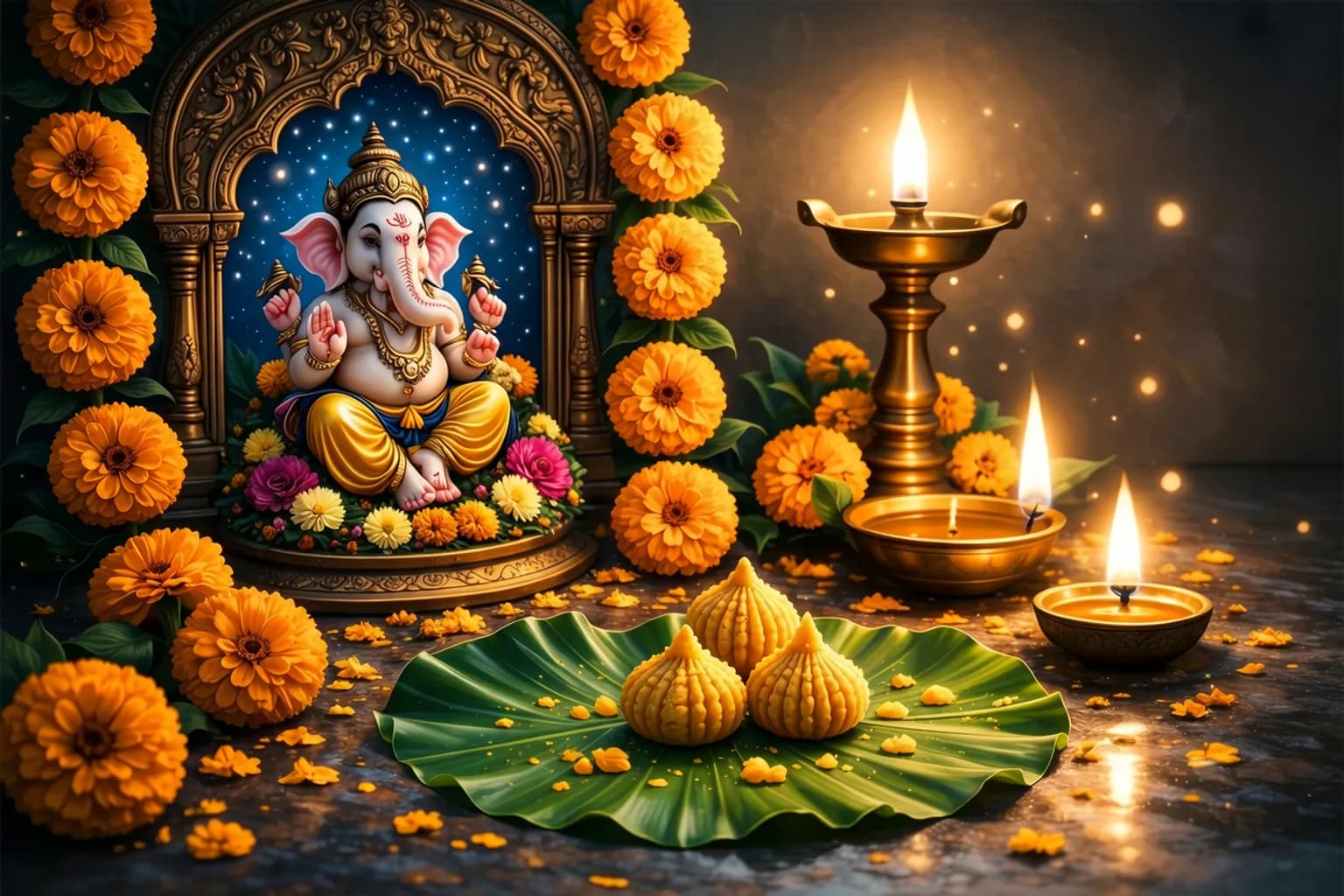
Walk into a Hindu home, shop, wedding, or new office anywhere on earth, and odds are the first deity you will meet is a cheerful god with an elephant's head, a round belly, and a bowl of sweets. Ganesha is invoked before every beginning: journeys, businesses, marriages, exams, books. Even the scribes of the great epic Mahabharata, the story goes, needed him; Ganesha himself served as its scribe, breaking off his own tusk to keep writing when the pen failed.
Of all the gods I have studied, none is loved with less fear than this one. That alone makes him worth understanding.
The Head That Was Lost and Found
The most famous story explains the head. Parvati, Shiva's wife, fashioned a boy from clay to guard her door while she bathed. Shiva, returning and refused entry by a child he did not recognise, struck the boy's head off in fury. Parvati's grief shook the worlds, and to repair the irreparable, Shiva replaced the head with the first one his attendants could find: an elephant's. The boy rose as Ganesha, first of the gods to be worshipped, the doorkeeper who once kept even Shiva out.
I have always found the story quietly devastating beneath its fairy-tale surface: a family rupture, an unfixable mistake, and a repair that does not undo the wound but transforms it into something beloved. Most families I know, including my own back in Beirut, contain a version of that arc.
What the Iconography Teaches
Every detail of Ganesha's image is a small sermon, and devotees read him like a page:
- The elephant head: wisdom, memory, and the strength to clear what blocks the path
- The large ears and small mouth: listen much, speak less
- The single tusk: keep what serves, sacrifice what does not, even of yourself
- The round belly: digest all of life, sweet and bitter alike
- The mouse at his feet: desire, tamed and ridden rather than killed
Ganesha removes obstacles, the tradition says, and places them too, because some walls are placed by wisdom to redirect the traveller.
That second half of the teaching is the part outsiders miss, and the part I find most mature: the same god governs the obstacle and its removal, because not every blocked road is a misfortune.
The Story Behind the Stories
Historically, Ganesha is a relative latecomer who conquered completely. He rises to prominence in roughly the fifth century of our era, and within a few centuries had his own devoted sect and a place at the threshold of every rite. Scholars debate his deeper origins, possible roots in older elephant cults or guardian spirits, but the historical arc is clear and rather wonderful: the god of beginnings began late, and started everywhere.
What Ganesha Teaches
Strip away the mythology and the teaching holds for anyone: honour the threshold. Beginnings deserve a pause, a moment of respect for what is being attempted, an honest reckoning with the obstacles, inner and outer, that stand on the path. Hindus give that pause a face, a name, and a sweet. It is among the most psychologically intelligent rituals I know: before you begin, befriend what blocks you.