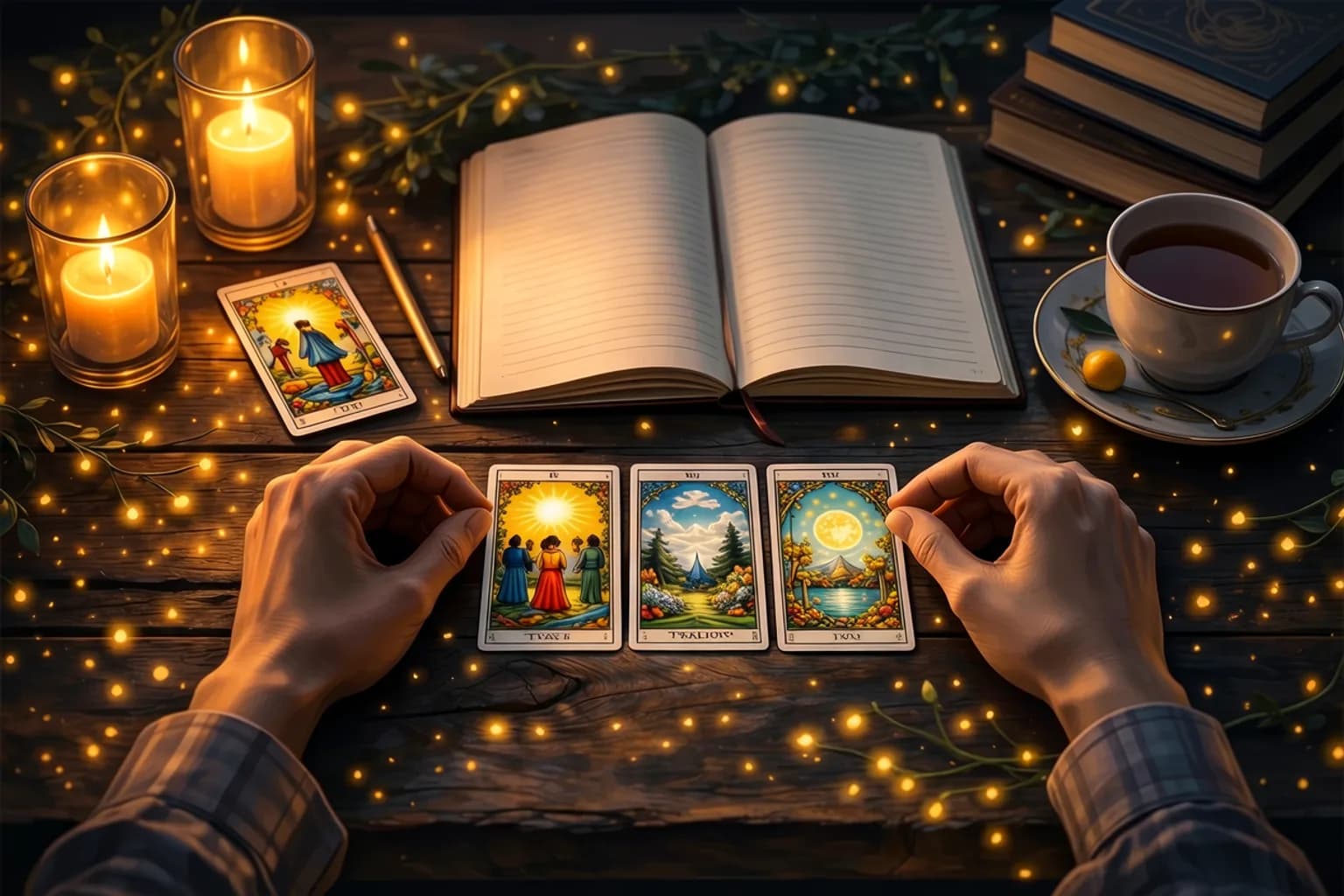
After a series of columns on the cards one by one, the question my inbox asks most deserves its own answer: how do I actually start? Here is the guide I wish someone had handed me twenty years ago, before the gatekeepers and the doom-merchants got their say. You need a deck, a notebook, and honesty. You do not need psychic gifts, and anyone who says otherwise is selling the wrong thing.
What a Reading Actually Is
Let me put my cards, so to speak, on the table, as I do in every column: tarot began as an Italian card game, was reinvented as an oracle centuries later, and works, in my long experience, not by predicting the future but by structuring reflection. A spread is a set of labelled questions; the cards are seventy-eight vivid prompts; and the reading is the conversation between the labels, the images, and what you already half-know. My sceptical colleague Petra calls it externalising the inner conversation, and she is right, and it loses no magic for being described accurately. Mirrors are genuinely useful instruments. They simply have to be pointed honestly.
Starting: The Daily Card
Skip the ten-card spreads for now. The practice that builds real fluency is one card, daily:
- Shuffle while holding a loose question: what does today need from me?
- Draw one card. Look at it before you look anything up: what is happening in the picture? Who would you be in it?
- Read the card's meaning, then write two or three sentences connecting image to day
- In the evening, add one line: where, if anywhere, did this show up?
Six weeks of this teaches more than any course, because the cards acquire your fingerprints: the Tower that marked the week your plans collapsed will never again be a memorised keyword. It will be that week, available as a lens.
The Three-Card Spread
When you want more than a daily mirror, three positions answer most questions: situation, obstacle, counsel. Lay them left to right and read them as a sentence, not three fragments. The skill of reading is connection: what story do these three images tell when forced to share a table? Resist the beginner's urge to redraw until the cards flatter; the spread you did not want is the one with information in it.
The deck never tells you anything you have no access to. It tells you what you have been avoiding access to, which is a different and far more useful service.
The Ethics, Briefly and Firmly
Because this practice has real effects on real people, the house rules at my table, non-negotiable for twenty years: no health predictions, no death predictions, no third-party spying on absent lovers, and no reading for someone who has not asked. The cards reflect the person who shuffles; pointed at the absent or the medical, they reflect only the reader's imagination, and frightened people deserve better than our imaginations. If a querent is in real trouble, the most powerful card in the deck is the phone number of an actual professional.
Reversals, Decks, and Other Worries
Beginners agonise over the wrong things. Reversals (upside-down cards): optional; read upright-only for your first year with my blessing. Which deck: the one whose images you want to keep looking at; the 1909 Smith-Waite images that this column's series describes are the common tongue, and a fine first language. Can you buy your own deck (the folklore says it must be gifted): you can, and should. Wrong shuffling: does not exist.
The only thing worth your worry is the only thing that was ever the practice: did you look honestly at what the mirror showed, and did you write it down? My grandmother kept her I Ching journal for fifty years on that one discipline. The tools differ. The honesty is the entire art.