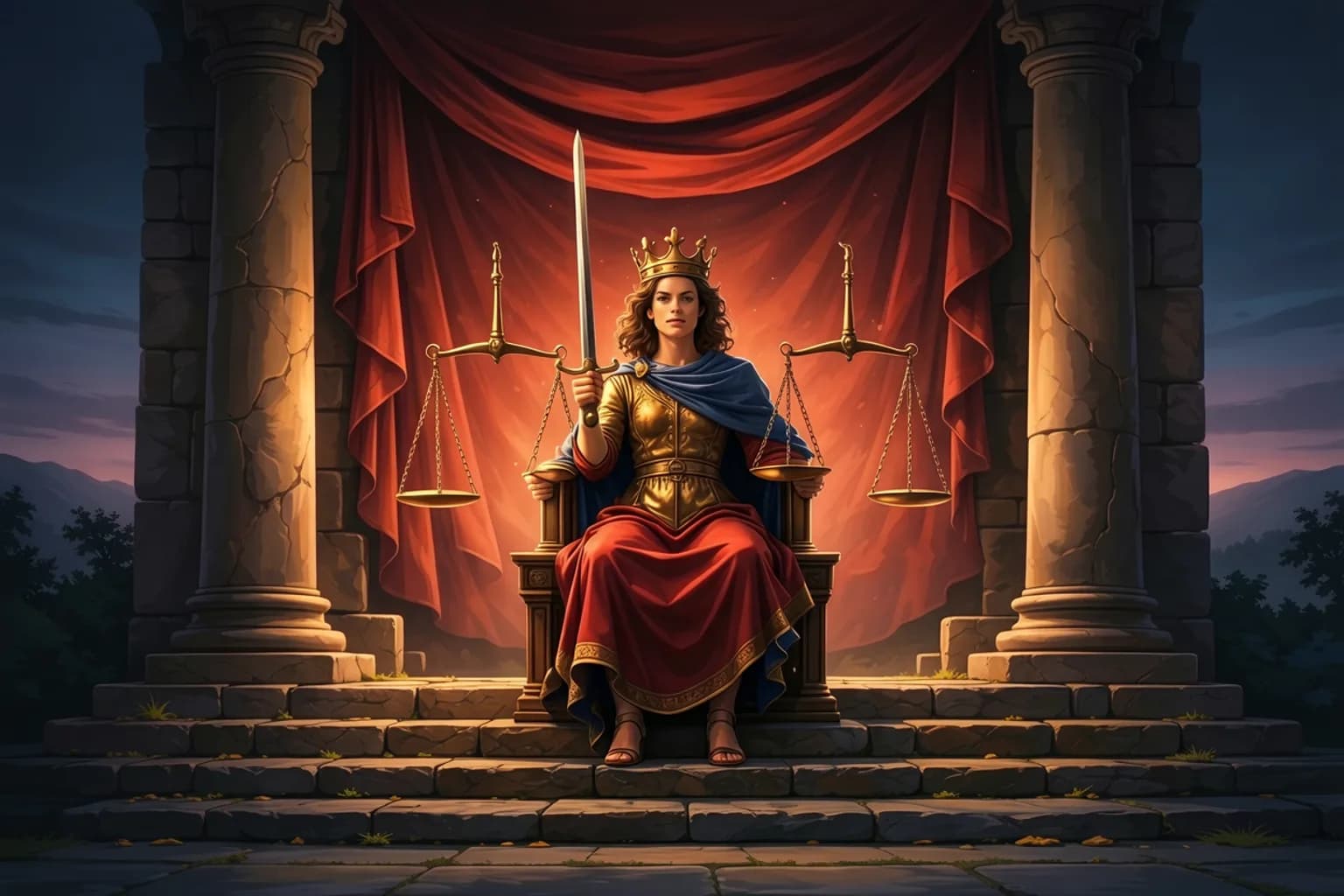
Card eleven sits enthroned between two pillars, crowned, holding a sword upright in one hand and scales level in the other, and unlike the famous courthouse statues, her eyes are open. The tarot's Justice is not blind. She sees everything and weighs it anyway, which is a far more demanding proposition, and the reason this card unsettles querents who came for comfort.
In my practice, Justice appears at reckonings: decisions with consequences, accounts coming due, truths requiring both instruments, the scales to weigh and the sword to act. She is the deck's adult in the room.
What Justice Means
Upright, the card gathers the weighing faculties:
- Cause and consequence: the harvest of what was actually planted, my colleague Dev would say karma with a Latin accent
- Truth told level: facts faced without thumb on the scale, including one's own thumb
- Fairness as practice: the decision made by what is right rather than what is comfortable
- Accountability: the account settled, the responsibility taken, the record corrected
She often arrives for querents narrating themselves as pure weather victims, and her question is gentle but total: which part of this situation did your own choices build? Not all of it, the card concedes. Never none of it, the scales insist.
Reversed: The Thumb on the Scale
Reversed, Justice names the crooked weighings: accountability dodged, the comfortable story preferred to the level one, the double standard, one scale for myself, another for everyone else, and the old favourite, fairness demanded loudly outward and never once applied inward. When she lands reversed in my journal, the audit is specific: where am I currently the unjust judge of my own case?
Justice holds the sword in the right hand and the scales in the left: weigh first, then act, and never the reverse. Most regret, the card observes, is swordwork done before the weighing.
Where This Really Comes From
The honest history, faithfully. Justice is, with Strength and Temperance, one of the cardinal virtues dealt into the original trionfi decks: a figure every medieval mind knew from cathedral porches and city halls, scales and sword and all, no Egypt required, none ever was. Her open eyes are the older tradition; the blindfold on courthouse statues arrived later in legal iconography, and the tarot, charmingly, never adopted it. The 1909 Smith deck moved her from eight to eleven in the famous renumbering, seating her at the exact centre of the Major Arcana, the fulcrum of the whole sequence, which whether esoteric bookkeeping or accident, reads today like a thesis: the deck balances on the card that balances.
My grandmother's I Ching kept its own Justice in hexagrams of correction and biting through; her pencilled margin beside one of them said, in characters I keep framed: the account does not close because you stopped reading it. Two traditions, one ledger.
Common Questions
Is Justice a yes or no? It is a verdict card: yes if your case is honest, no if it is not, and it knows the difference even when the querent has stopped admitting it.
What does Justice mean in love? The relationship's accounting: imbalances named, fairness restored, the partner weighed as they are rather than as advertised. Reversed, the ledger one partner keeps and the other never sees.
Does Justice mean legal matters? Sometimes literally: contracts, agreements, proceedings. More often the inner courtroom, which sits more days per year than any other.
A Reflection, Not a Prediction
When Justice appears, open the books. Choose the situation currently most narrated and least audited in your life, and write two honest columns: what was done to me, what I did. Most people, my twenty years of tables suggest, have one column memorised and one column blank. Fill the blank one. Then, and only then, pick up the sword, which in daylight means the conversation, the correction, the changed term. The scales before the sword. The card has never once reversed the order.