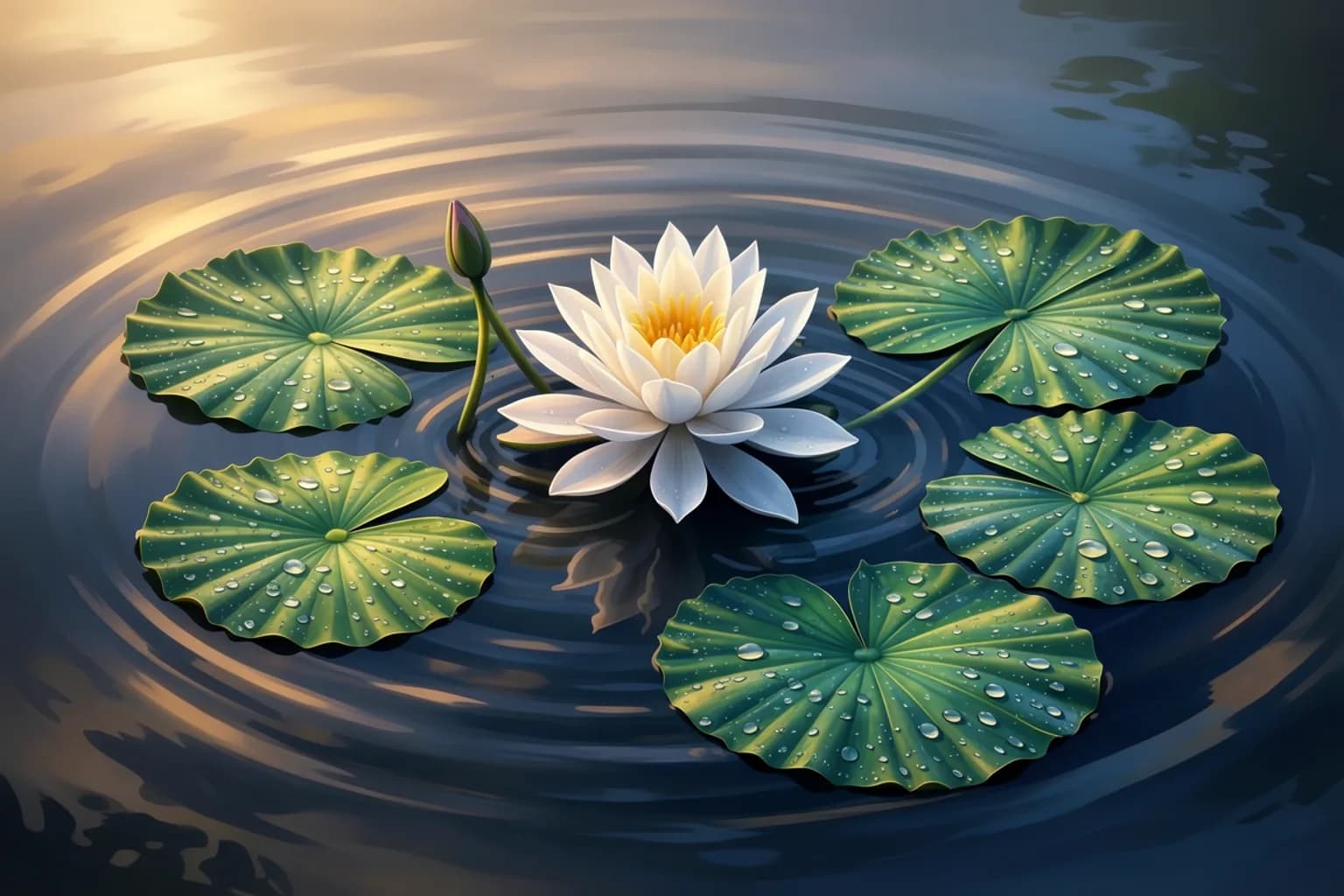
Nearly every god my colleague Omar writes about in these pages is standing, sitting, or being born on the same flower. Lakshmi on her pink lotus, Saraswati on her white one, Brahma blooming from Vishnu's navel on a lotus stem, the Buddha enthroned on lotus cushions across half of Asia. When one image carries that much divine furniture, it has earned a column of its own.
The lotus is the East's master symbol, and like most things grown familiar, its actual teaching has gone quiet beneath its prettiness. The teaching deserves the volume turned back up, because it is not gentle.
The Symbol, Read Properly
The lotus means what it does because of how it grows, and every detail is doctrine:
- It roots in mud. Not despite the muck but in it; the filth of the pond bottom is its only soil. No mud, no lotus, as the Buddhist teachers say.
- It rises through murky water without taking the murk along, the stem a long patience between bottom and light.
- It flowers above the surface, immaculate, while still attached, always, to the mud below.
- Its leaves shed water. Even botany cooperates: the lotus leaf is the textbook example of a surface nothing clings to, and the old poets knew it centuries before the microscopes, praising the sage who lives in the world as the lotus leaf lives on water, touched and unstained.
The lotus does not teach purity instead of mud. It teaches purity made from mud, which is the only kind on offer to anyone born in a pond.
What the Teaching Demands
Read honestly, the lotus is a demanding flower. It refuses both escapes that humans prefer: it will not pretend the mud is clean, and it will not stay down in the mud calling the murk realism. Its whole life is the third option, the conversion of sediment into blossom, the daily transmutation of exactly the circumstances one would not have chosen.
My Dadi, who fed strangers every Thursday of a life that gave her ample mud, never quoted the Upanishads about lotuses. She was one, which is the only commentary the symbol finally accepts.
Where This Really Comes From
The honest history, in this series' tradition. The lotus is genuinely, certifiably ancient: it opens in Egypt, where the blue lotus closing at night and rising with the dawn made it the sun's own flower, born from the primordial waters in the oldest creation accounts. India gave it the metaphysics, from the Vedas onward; Buddhism carried it east, grading enlightenment itself by the bloom, the closed bud, the opening flower, the full thousand petals of my colleague's crown chakra column; and Asia's art has never since designed a heaven without it.
Unusually for this series, there is no modern fabrication to expose. The lotus is the rare symbol whose paperwork checks out across four millennia and three continents. Even Petra, our resident auditor, would initial this one.
A Practice, Not a Decoration
If the lotus lives anywhere in your life, on a shelf, a wrist, a yoga mat, let it ask its actual question now and then: what mud am I currently in, and what is it for? The symbol's answer is always the same and never comfortable: the mud is not the interruption of the flowering. It is the ingredient. Name the muck honestly, root in it deliberately, and grow the long stem with patience, because the surface, the old image promises, is real, and the bloom takes no stain from the journey. The pond, meanwhile, remains a pond. That was never the problem.