My Dadi's mala hung at her wrist through every scene of my childhood: tulsi wood gone smooth as river stone, one bead always travelling under her thumb while she cooked, scolded, bargained, and prayed. When she died, the mala came to me, and I learned its first teaching the day I picked it up: a tool used daily for sixty years carries the use in its surface. No app will ever show you its odometer like that.
What a Mala Is
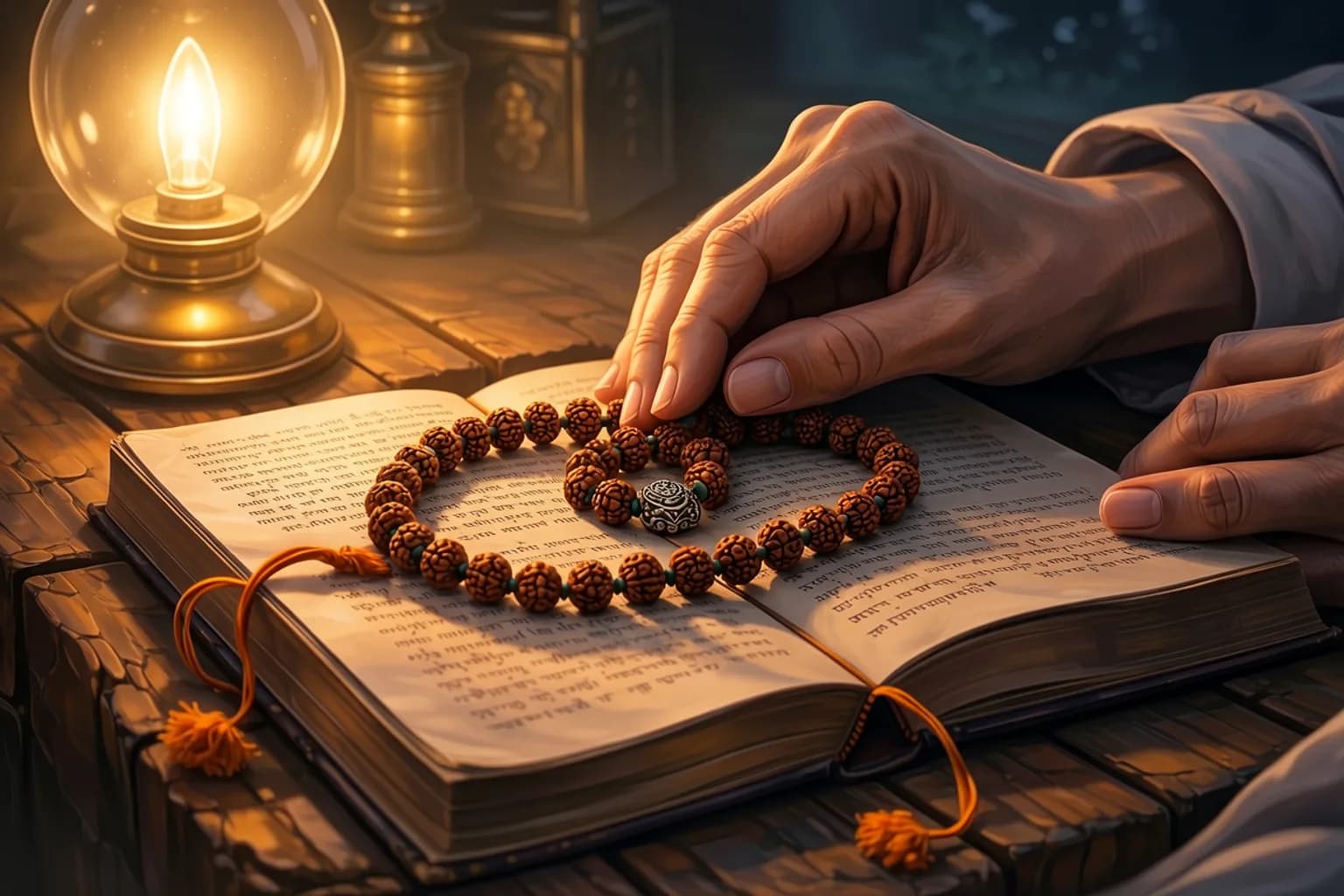
A mala is a string of beads, classically 108 plus one larger guru bead, used to count repetitions of a mantra, a name, or a breath. The thumb advances one bead per repetition; the mind, anchored by the hand, wanders less; and the round ends where it began, at the guru bead, which is not counted but honoured: the teacher, the source, the place you do not step over but turn back from.
- The counting frees the mind from counting, which is the practical genius of the tool
- The touch keeps the body in the prayer, recruiting the hand as the mind's anchor
- The circle makes practice tangible: a round is a real, finished thing
- The guru bead teaches the turn: practice circles back to gratitude, not past it
Why 108
The famous number has a dozen explanations and the honest answer is that the tradition loves them all: 108 as the product of sacred arithmetic, the number of Upanishads by classical count, the names of the deity, the distances of sun and moon in old cosmology. My grandfather's answer remains my favourite for its farmer's practicality: the number is large enough that finishing means something, and the explanations, he said, were invented afterward by men who had already finished their rounds. Some numbers earn their sanctity by being used.
The mala's secret is not the number or the wood. It is that the hand, given one bead at a time, teaches the mind what one thing at a time feels like.
Where This Really Comes From
The honest history, as in all my pieces. Prayer beads are genuinely ancient and genuinely Indian in origin: the earliest clear evidence sits in Indian traditions over two thousand years ago, and the tool travelled outward with Buddhism along the trade roads, becoming the Chinese and Japanese juzu, and westward, most scholars hold, influencing the Islamic misbaha and meeting the Christian rosary's development on the way. The whole praying world, in other words, ended up with beads in its hands, and the family tree points home to India.
What is modern is the boutique mala: the gemstone-by-intention catalogue, this stone for abundance, that one for calm, which borrows more from the crystal aisle my colleague Petra has audited than from any classical source. The old texts specify materials by tradition, tulsi, rudraksha, bone, sandalwood, not by retail psychology.
A Practice, Not an Accessory
If a mala comes into your life, give it a job, because an unworked mala is just a necklace with a rumour. The practice is simple: one round daily, one phrase that matters to you, sacred or plain, one bead per repetition, thumb never rushing. The first week the hand fidgets; by the third, the round has become a small room you can enter anywhere, on trains, in waiting rooms, in grief. Sixty years of that built the smoothness on my Dadi's beads. The smoothness was never the wood. It was the visits.