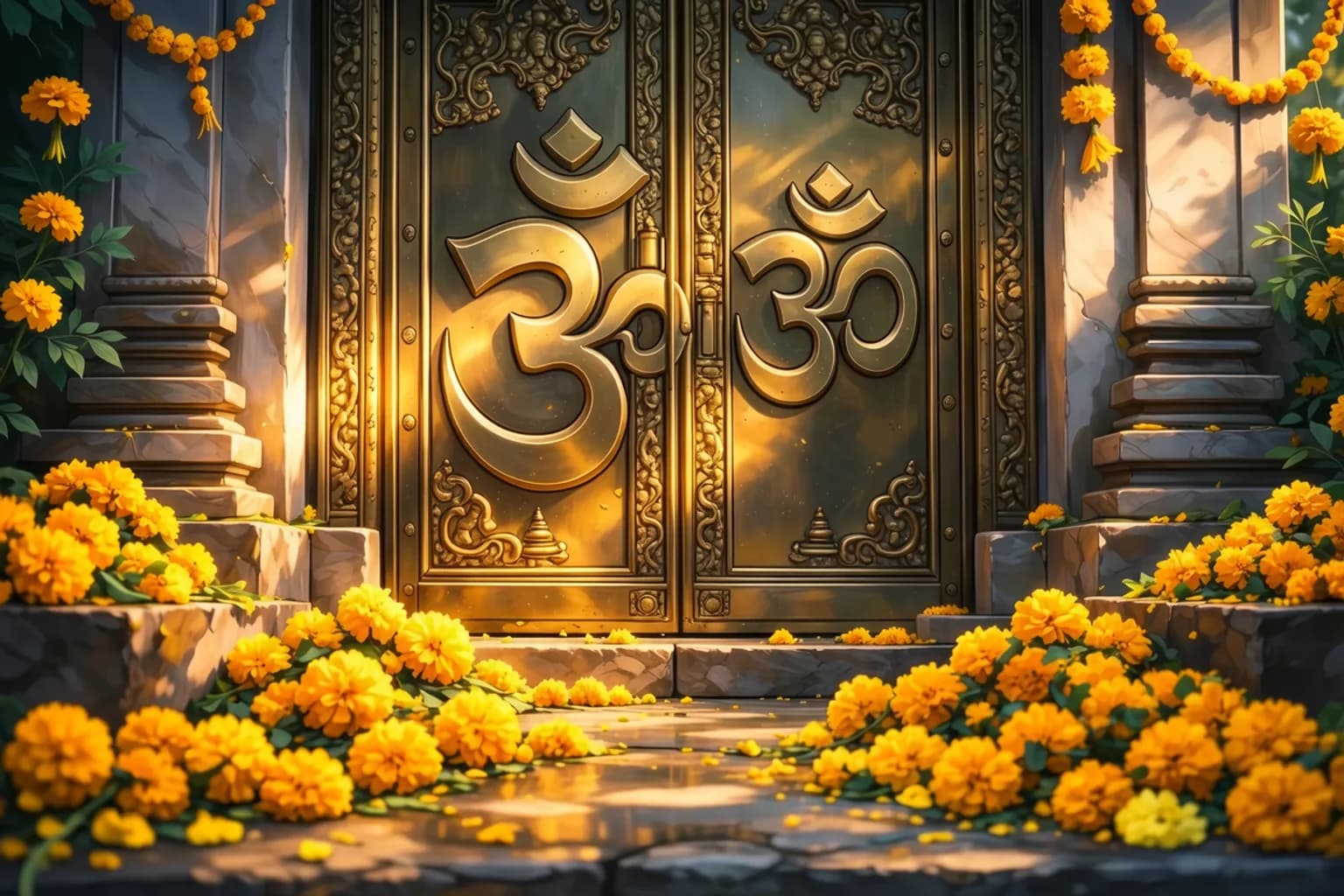
It hangs in yoga studios from Delhi to Denver, inks forearms on every continent, and opens and closes more chants than any syllable in human history. Om, or more precisely Aum, is likely the most recognised sacred symbol on earth, and, I say this gently, one of the least understood by those who wear it. Since my own grandfather began every dawn with it, three long syllables over the Ganga before the scriptures opened, let me offer what the tradition actually holds.
One Syllable, Built of Three
The teaching begins with the sound itself, which the Upanishads treat not as a word but as the word: the seed-syllable of reality. Chanted fully, Aum unfolds in three parts and a silence:
- A, opening at the back of the throat: beginning, the waking state, the world of things
- U, rolling across the middle of the mouth: continuation, the dreaming state, the world of mind
- M, closing at the lips: dissolution, deep sleep, the unmanifest
- The silence after: the fourth state, turiya, the awareness that holds the other three
One syllable, the tradition says, rehearses the entire arc: arising, abiding, dissolving, and the stillness beneath all three. My grandfather never explained this to me as philosophy. He simply made the M last longest, and then sat in the fourth part, and the fourth part, I eventually understood, was the point.
Aum is the whole journey pronounced: everything begins, persists, and ends, and what remains after the lips close is what you actually are.
The Mark Itself
The visual symbol, the elegant numeral-three with its tail and crescent and dot, is the syllable written in Devanagari script, stylised over centuries. The tradition reads its parts as the same map: the large curves for waking and dream, the tail for deep sleep, the crescent for the veil of illusion, and the dot above as turiya, the witness past the veil. Whether the calligraphy was designed to mean this or grew into the meaning, as letters do, the result is rare: a script character that became a complete diagram of consciousness.
Where This Really Comes From
The honest history, as in all my pieces. Om is genuinely ancient, which in this publication's origin series has become almost surprising: it sounds through the Vedas and receives its great philosophical treatment in the Upanishads, well over two thousand years ago; the Mandukya Upanishad is, in its entirety, a meditation on this one syllable. It crossed into Buddhism and Jainism, each tradition keeping the seed and growing its own tree.
What is modern is the decoration: the symbol's career on apparel, jewellery, and studio walls dates mostly from the twentieth century's westward yoga migrations. I am less offended by this than some. A sacred syllable that survived three millennia can survive a t-shirt. But it deserves to be more than worn.
A Practice, Not a Logo
If you keep the symbol anywhere in your life, let it earn its place once a day. Sit, breathe, and sound it slowly three times: A from the belly, U across the heart, M closed at the lips and held, then the silence, held longer. Notice that the silence is not empty; it is the part of you that was listening. That part, the Upanishads say, is the oldest thing you own, older than the syllable itself. The symbol on the wall is a reminder. The fourth part is the destination, and it is closer than the wall.