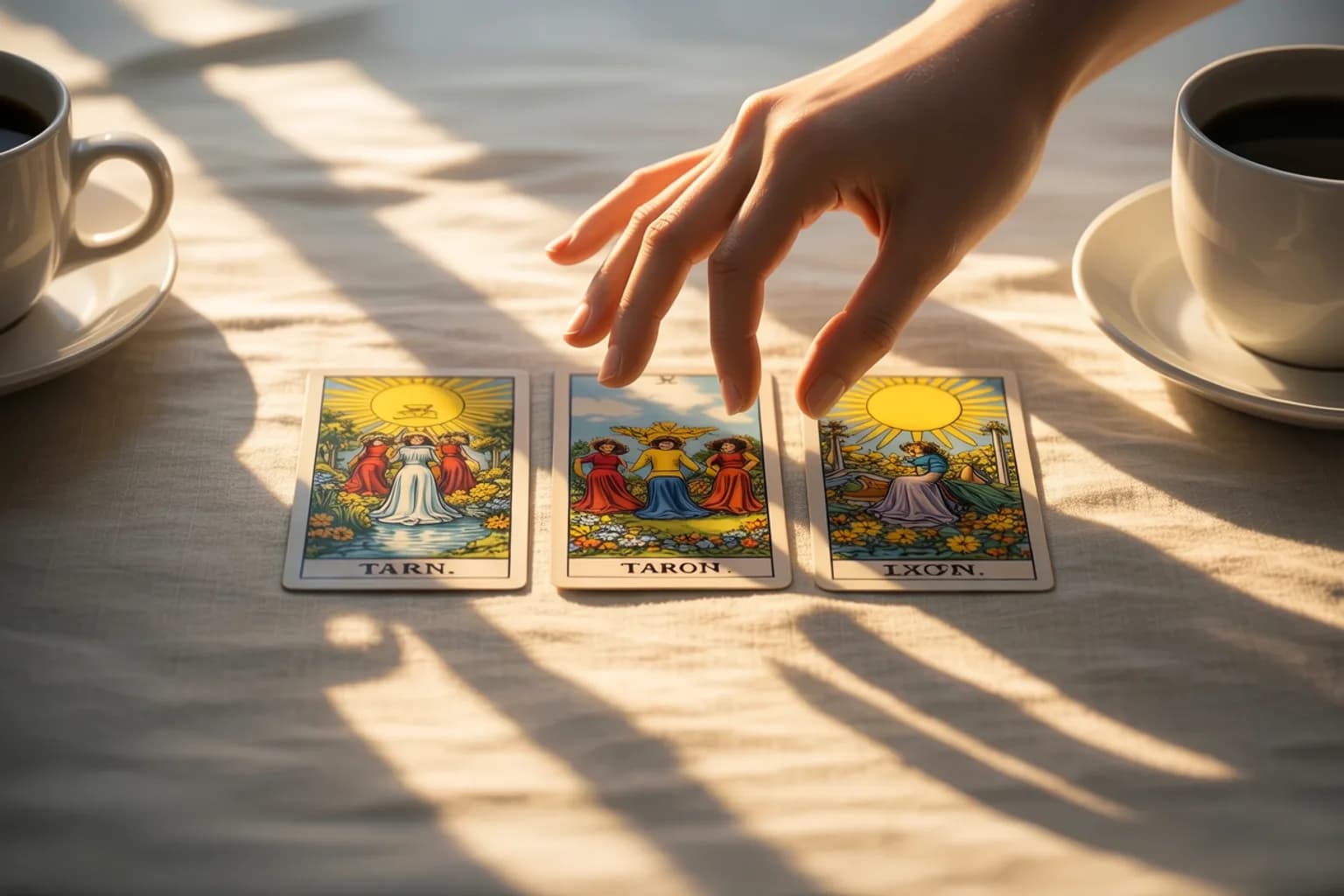
My guide to reading tarot made the case that the cards are a reflective instrument, not a fortune machine. This companion piece is the toolbox: the three spreads I actually use, after twenty years and a drawer full of abandoned complicated ones. The famous ten-card Celtic Cross is a fine cathedral, and beginners get lost in it for years. These three rooms, honestly furnished, hold everything.
One Card: The Daily Mirror
The foundation, covered fully in the how-to guide, and repeated here because it outranks everything else: one card, one loose question, two written sentences in the morning, one in the evening. Fluency comes from this practice and nowhere else. Every master reader I respect, whatever cathedral they perform in publicly, keeps this small room privately.
Three Cards: The Workhorse
Three positions, left to right, and the label set you choose is itself the skill. My most-used variants:
- Situation, obstacle, counsel: the general-purpose reading; ninety percent of my own journal entries
- What I am holding, what I am avoiding, what is asking to change: the honest inventory, best taken on Sunday evenings
- Body, heart, mind: the check-in when something is off and unnamed; let each card describe one floor of the house
- What this relationship gives, what it costs, what it needs: the bond audit, applied to people, jobs, and habits alike
Read the three as one sentence, never as three fragments. The information lives in the joins: the Hermit as obstacle means something entirely different beside the Lovers than beside the Tower. And one house rule from my table: the spread is read once, written down, and left alone. Re-asking the same question until the deck flatters you is not divination. It is haggling.
Small spreads are not training wheels. They are the bicycle. The big layouts mostly add places for the same honesty to hide.
Five Cards: The Crossroads
For genuine decisions, the only larger spread I keep. Lay one card for where you stand, two for the road of choice A, two for the road of choice B: for each road, one card for its honest gift, one for its honest price. The structure embodies the only decision wisdom I trust, learned as much from my grandmother's I Ching as from any deck: real options have both a gift and a price, and the chooser's job is to pick which price they can pay cheerfully, not to find the road without one. A reading that shows one road all sunshine is reporting your bias, not your future; note the bias, that is real information too, and read again next week.
The Rules of the House
Whatever the spread, the same ethics from the main guide apply: no health or death predictions, no spying on absent parties, nothing read for someone who did not ask. Add the journal rule, the spread not written down evaporates by lunch, and the sufficiency rule: if a reading surfaces something heavy, the next step is a human being, a friend, a professional, a phone call, never a bigger spread. The cards are a fine place to find the question. People are where the answers have always lived.
Three rooms, then: the mirror, the workhorse, the crossroads. Furnish them with honesty, visit one daily, and you will outgrow most of what is sold as advanced. The deck has seventy-eight cards, but the practice, my grandmother would want me to tell you, has always had exactly one: look clearly, write it down, live accordingly.