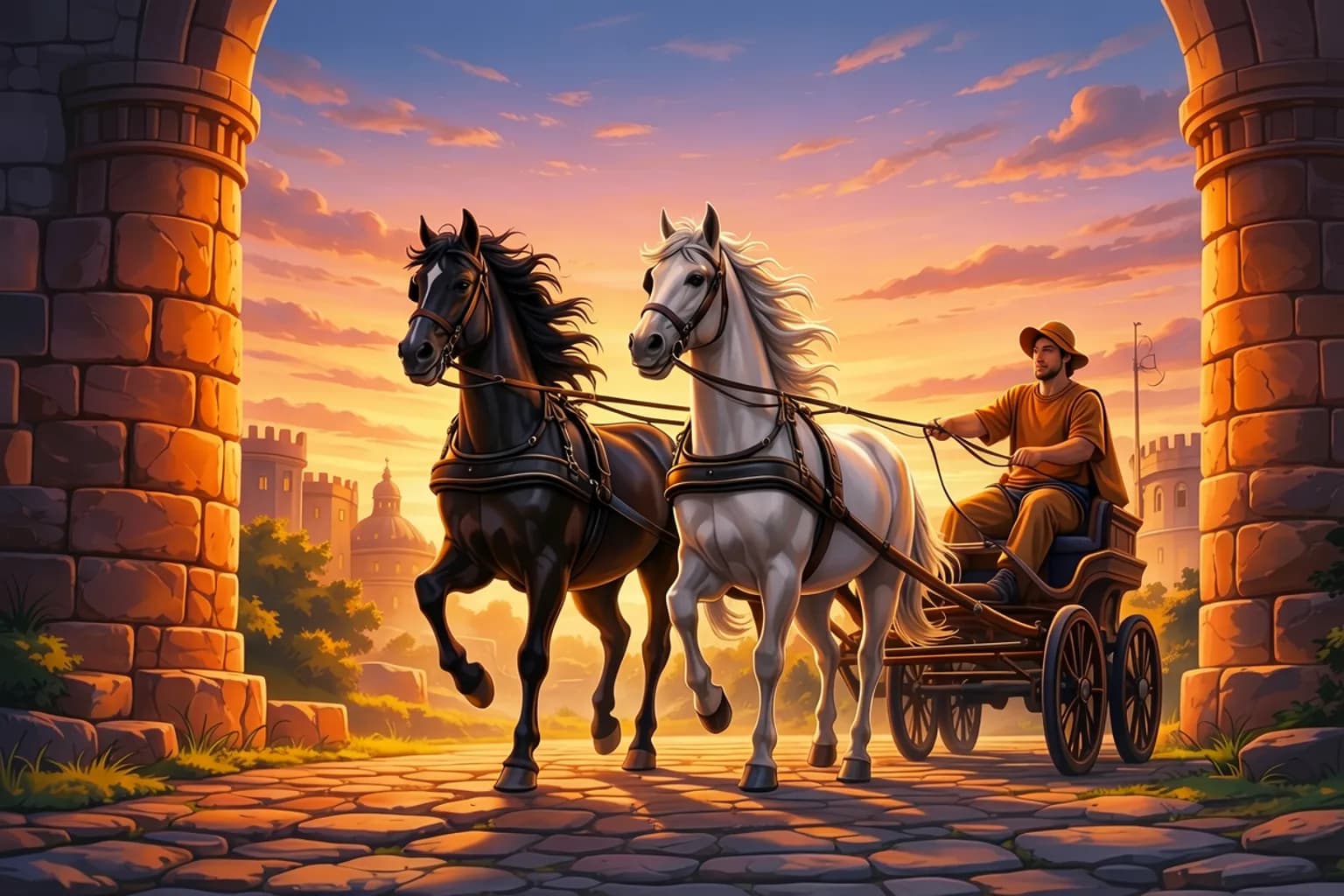
Card seven is the deck's first victory, and the strangest vehicle ever drawn. An armored figure stands in a chariot pulled by two sphinxes, one black, one white, facing subtly different directions, and if you look for the reins you will not find them. There are none. The Chariot is steered, the image insists, by will alone: the driver's inner command is the only harness.
That missing harness is the entire teaching, and it is why this card means something deeper than winning.
What the Chariot Means
Upright, the Chariot gathers the faculties of directed force:
- Willpower: desires and contradictions yoked to a single chosen direction
- Victory through discipline: the win earned by holding course, not by luck
- Momentum: a season for advance, the vehicle finally moving
- Self-mastery as the engine: outer conquest resting entirely on inner command
The two sphinxes are the card's honesty about human nature: we are always pulled by opposed creatures, ambition and fear, head and heart, the urge to arrive and the urge to flee. The Chariot does not kill either animal. It makes them pull together.
Reversed: The Vehicle Without a Driver
Reversed, the Chariot is force scattered or force misruling. The sphinxes pulling apart: a life lurching between contradictory wants, motion without direction, busyness mistaken for progress. Or the driver turned tyrant: control gripped so hard the wheels leave the road, the victory pursued past its worth, my colleague Arjun would call it will without witness. Reversed, the question in my journal is mechanical: do I lack a direction, or am I strangling one?
The Chariot has no reins because none would help. The animals that pull a life are only ever steered from inside the driver.
Where This Really Comes From
The honest history, as every card receives in this series. The chariot was the Renaissance triumph made literal: Italian trionfi decks drew on the actual triumphal processions of the era, parade floats of virtue and victory rolling through city streets, and early cards show a crowned figure in a parade car. The sphinxes, the starry canopy, the esoteric geometry arrived with the nineteenth century occultists, and the 1909 Smith deck fixed the version we read today.
So the card began as a parade and became an examination of the driver, which is, if you think about it, the history of every victory worth having: first the crowd and the float, then, later, the quiet question of who was actually steering and toward what.
Common Questions
Is the Chariot a yes? For ventures requiring drive and discipline, a strong yes, with the condition built in: the yes is to the driver, not the passenger.
What does the Chariot mean in love? Pursuit and direction: a relationship advancing by intention. Reversed, two sphinxes and no agreed road, each partner steering a different chariot.
Chariot versus the Magician? The Magician has the tools; the Chariot has the momentum. One is capability claimed, the other is contradiction harnessed and moving.
A Reflection, Not a Prediction
When the Chariot appears, name your two sphinxes honestly: the pair of opposed pulls currently dividing your power, the ambition and the fear, the duty and the desire. Write them down, side by side, black and white. Then ask what single direction could employ them both, because the card's secret is that the animals do not need to agree with each other. They need only to answer to you.