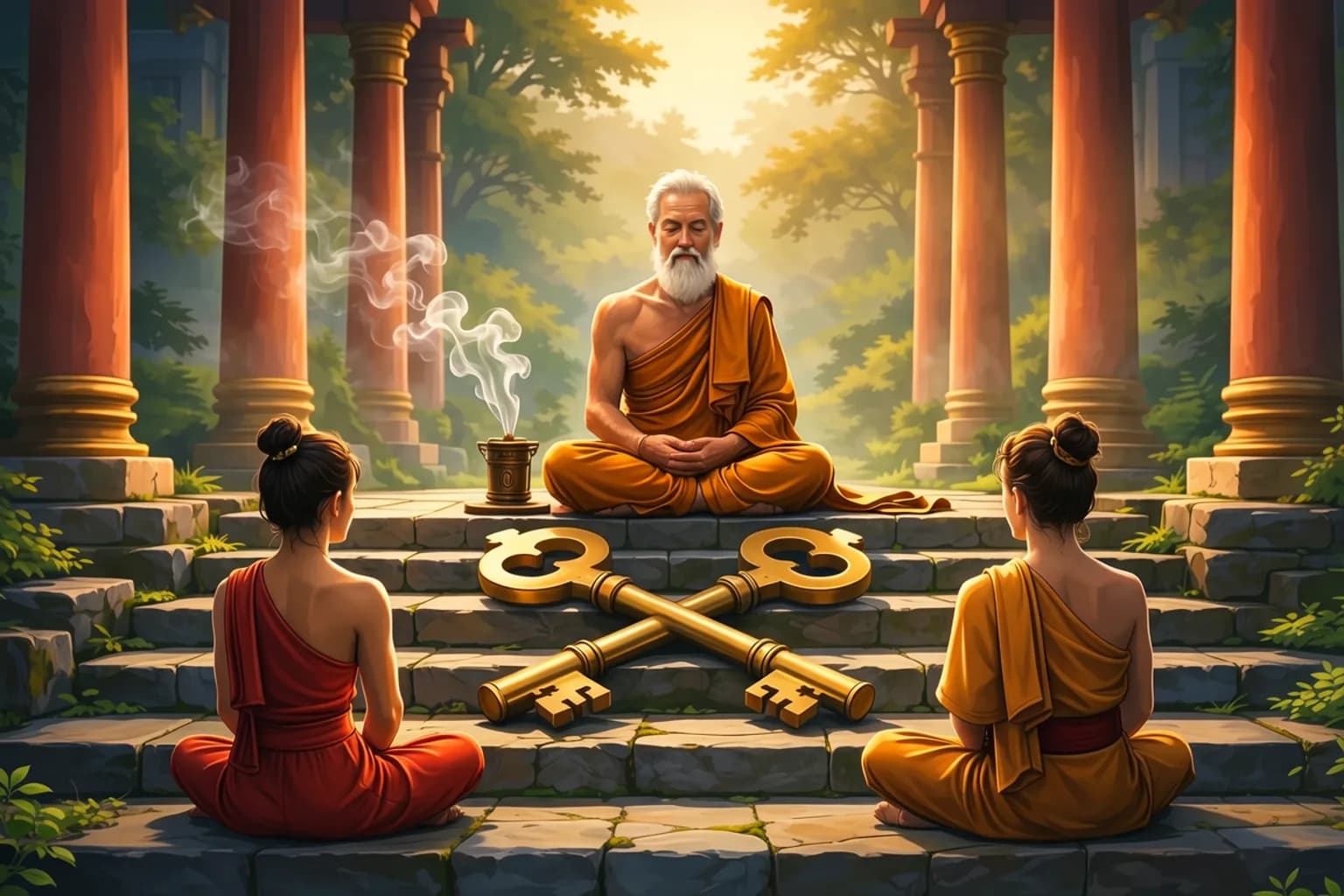
Card five is the one modern readers squirm at, which is exactly why it earns its keep. The Hierophant sits enthroned between pillars like the High Priestess, but where she guards inner knowing, he transmits outer teaching: hand raised in blessing, keys crossed at his feet, two students kneeling to receive what generations have carried. He is the card of tradition, instruction, and belonging to something older than yourself.
In an age that prizes the self-taught and the self-made, the Hierophant arrives in readings like a question nobody wanted: what if some things cannot be learned alone?
What the Hierophant Means
Upright, he gathers the transmissive faculties:
- Tradition as a vessel: practices, faiths, and crafts refined by generations
- Teachers and mentors: knowledge that passes person to person, not screen to screen
- Belonging: institutions, communities, lineages, the strength of shared structure
- Conventional wisdom honoured: the established way as a sane default
He often appears when a seeker is reinventing wheels that a tradition long ago perfected, or when a community, a marriage, a discipline, an apprenticeship, is exactly the medicine independence cannot provide.
Reversed: The Inherited Way Outgrown
Reversed, the Hierophant is the card of necessary heresy. Dogma where teaching should be; the rule kept after its reason died; the institution serving itself; the inherited belief never once examined by its inheritor. Upside down, he blesses the respectful departure: leaving the church, the firm, the family script, not in contempt but in growth. When he lands reversed in my journal, the question is precise: which inherited rule am I obeying that I have never actually chosen?
The Hierophant holds both keys: one opens the door into tradition, the other opens the door out. Wisdom is knowing which door is yours this year.
Where This Really Comes From
The honest history, faithfully. In the Italian decks this card was simply Il Papa, the Pope, partner to the Popess, the supreme spiritual authority of the medieval world rendered as a game piece, scandalous enough that some regions replaced both cards. The exotic title Hierophant, borrowed from the priesthood of ancient Greek mysteries, was applied by occultists centuries later to scrub the Catholicism off. So the card's own biography enacts its meaning: a tradition, inherited, renamed, adapted, carried forward changed. I cannot think of a more honest emblem for the whole question he poses.
My grandmother would have understood this card without explanation. Her I Ching came to her from her mother, with marginalia. Some pages she obeyed, some she argued with in pencil. That, the card says, is the right relationship to every inheritance.
Common Questions
Is the Hierophant a yes or no card? A yes to the conventional path, the commitment, the training, the established route; a no to shortcuts around necessary apprenticeships.
What does the Hierophant mean in love? Tradition's forms: commitment, ceremony, meeting the family, shared values. Reversed: a relationship needing its own rules rather than inherited ones.
Does he mean religion? Sometimes literally. More broadly: any structured lineage of meaning, a faith, a craft guild, a twelve-step room, a dojo.
A Reflection, Not a Prediction
When the Hierophant appears, take inventory of your inheritances: the beliefs, practices, and rules you carry from family, faith, culture, profession. Choose one and ask whether you have ever actually examined it. Keep it consciously, or set it down respectfully. The Hierophant is not asking for obedience. He is asking that nothing in your life be on autopilot that deserves a decision.