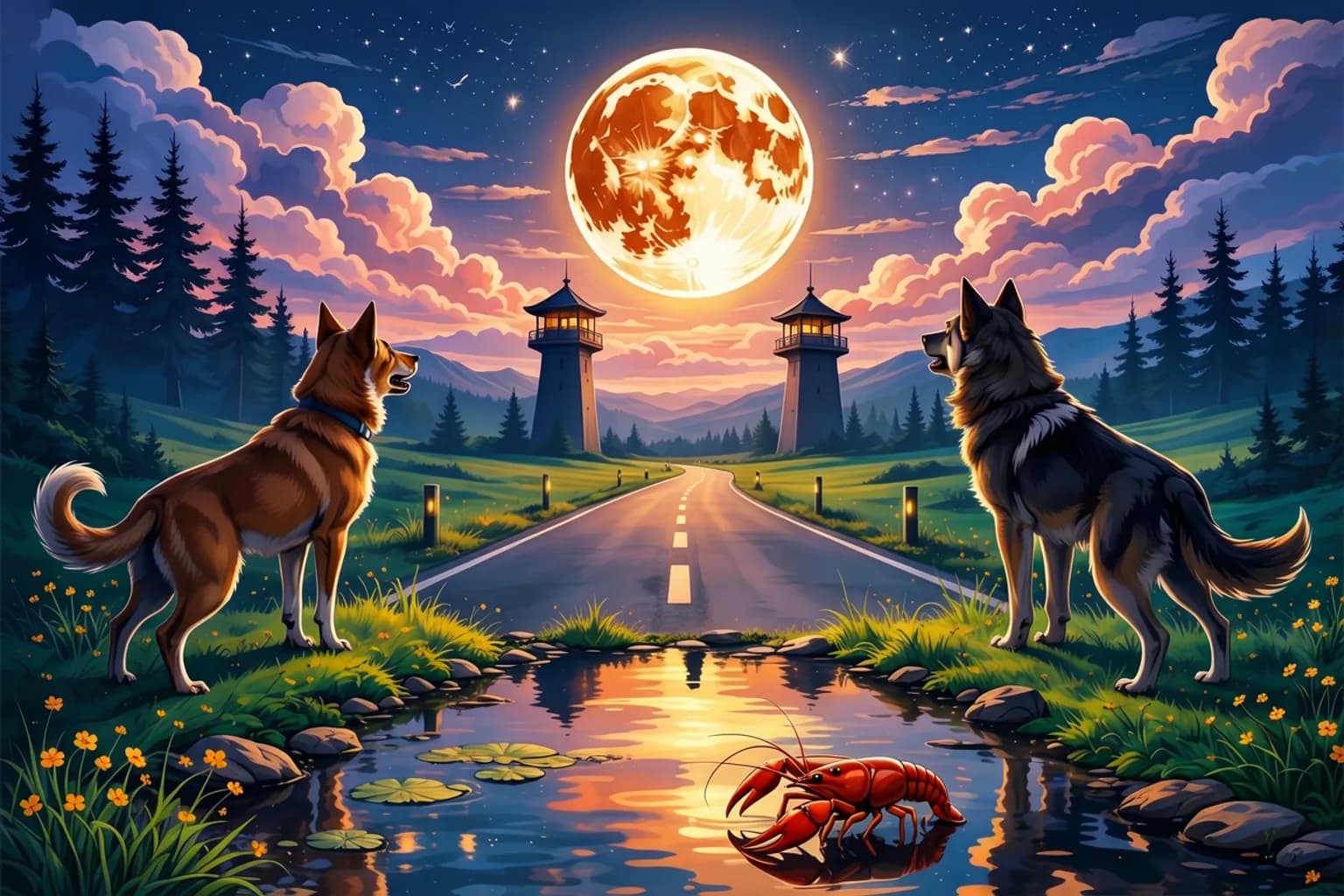
Card eighteen is the deck's night country. A moon, neither full nor friendly, half a face and a falling dew of light, hangs between two towers. A dog and a wolf howl up at it; a crayfish climbs from the pool at the bottom of the picture; and a pale road runs between all of them toward mountains the light does not reach. Nothing in the image attacks. Everything in the image unsettles. That is precisely the territory: the Moon governs not danger but uncertainty, the hours and seasons when nothing can be verified and the mind, unsupervised, does its own drawing.
This is the card of three a.m., and I have never met a querent who needed it explained, only located.
What the Moon Means
Upright, the card gathers the night faculties:
- Illusion: things seen by inadequate light, half-true and convincingly arranged
- Fear with no verifiable object: the dog and the wolf, the domestic worry and the wild one, howling at the same blank face
- The unconscious surfacing: the crayfish from the pool, old material climbing into the open at exactly the hour you cannot check it
- Intuition in its raw state: real signal mixed with static, the night's information that must be carried to morning before it can be sorted
The road is the card's secret: it runs straight through the picture, between the howling, past the towers, and out. The Moon never says stop. It says: keep walking, verify nothing at this hour, and do not negotiate with what the half-light shows you.
Reversed: The Fog Lifting or Loved
Reversed, the Moon turns one of two ways: the fog lifting, confusion resolving, the fear finally fact-checked against daylight and found mostly shadow, or the fog kept, the drama of uncertainty preferred to the duller work of clarity, anxiety rehearsed because it has become familiar company. When it lands reversed in my journal, the audit is honest: am I emerging from the night country, or have I been renewing the lease?
The Moon's law is the oldest night-walking rule there is: at this light, you may keep moving, but you may not draw conclusions.
Where This Really Comes From
The honest history, faithfully. The early Moon cards were calmer: astronomers measuring, women spinning by moonlight, the moon as timekeeper of the old agricultural night. The unsettling dreamscape, towers, dogs, crayfish and all, is substantially the occultists' and the 1909 Smith deck's invention, built from astrological Pisces imagery and the era's new fascination with the unconscious; the card grew stranger, fittingly, exactly as the modern mind discovered how strange its own nights were. My grandmother's I Ching kept the same country under the hexagram for darkening of the light, with her pencilled rule beside it, the one I now give every three a.m. querent: no letters before breakfast.
Common Questions
Is the Moon a bad card? It is an unverified card: it marks seasons where the data is poor and the feelings are loud. Bad decisions in such seasons come from forgetting which is which.
What does the Moon mean in love? Uncertainty in the bond: signals unread or misread, fears projected on a partner's silence. The counsel is the road's: keep walking, ask in daylight, conclude nothing at three a.m.
Moon versus the Star? The Star is the fixed light, faint and faithful; the Moon is the changing light, lovely and unreliable. Navigate by one. Admire the other.
A Reflection, Not a Prediction
When the Moon appears, institute night rules, and write them down while it is still day: no major conclusions after a certain hour, no message-sending from inside the fear, one trusted person as the morning fact-check. Then let the crayfish climb; what surfaces in your nights is real material, and it will keep until breakfast, when the dog turns out to be the neighbour's, the wolf turns out to be the wind, and the road, by ordinary daylight, was always just a road.