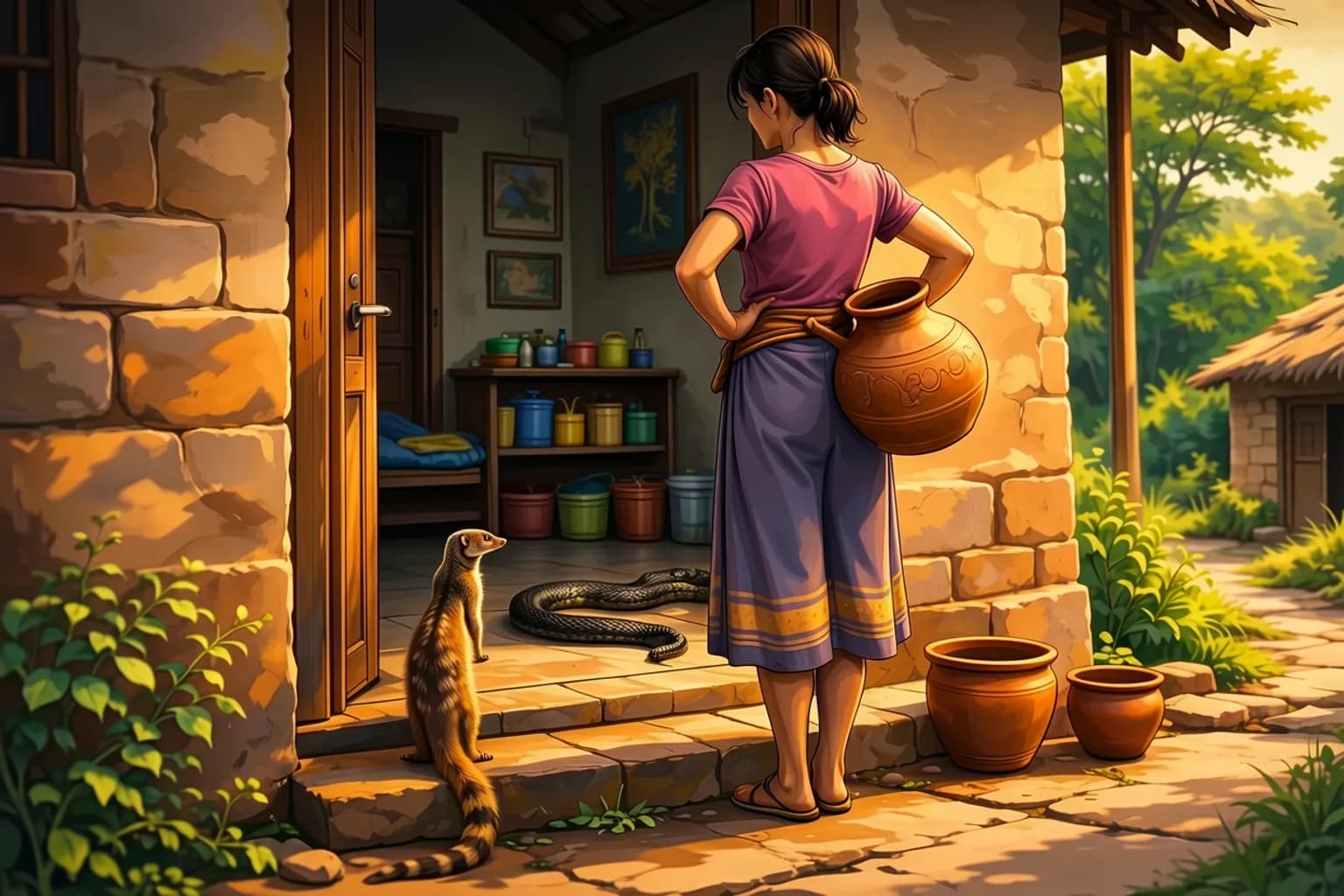
A brahmin and his wife had a son late, after years of hoping, and around the same time the brahmin brought home a young mongoose and raised it in the house alongside the boy.
The mongoose grew up beside the cradle. It slept near it. It followed the child around when he began to crawl. The husband trusted it completely and the wife never quite did, because it was a wild animal with teeth and her son was very small, and she watched it in a way she could not explain.
One day she had to go to the river for water and the child was asleep, and her husband said he would stay. Then he was called out on business and he went, because the boy was asleep and the mongoose was there, and he did not think twice about it.
While the house was empty a black snake came in through the wall and crossed the floor towards the cradle.
The mongoose met it. It fought the snake the way mongooses fight snakes, which is fast and without much margin, and when it was finished the snake was in pieces on the floor and the boy had not woken up.
Then it heard the wife coming back up the path, and it ran out to meet her, pleased with itself, wanting to be seen.
She looked down and saw an animal coming at her with blood around its mouth, out of a house where she had left her sleeping child.
She did not think. There was nothing in her that was capable of thinking. She had a heavy water jar on her hip and she brought it down and killed the mongoose where it stood, and then she ran inside.
The boy was asleep in the cradle exactly as she had left him. The snake lay in pieces across the floor.
She went back out and sat down beside the animal she had raised from a kit, and that was the position her husband found her in when he came home.
The Lesson of the Brahmin and the Mongoose
Speed is the enemy, not stupidity. Her reasoning was not bad. Blood, an animal, a baby out of sight. Given one second, almost anyone assembles the same picture. The failure was not in the conclusion, it was in the decision to act on a one second conclusion irreversibly.
Ask what else the evidence could mean before you do the thing you cannot undo. There is almost always a version of the scene where you are wrong, and it costs nothing to spend ten seconds looking for it, and it is the ten seconds nobody spends.
Notice who left. The story is careful about this and most retellings are not. Two adults left a baby alone in a house, and neither of them is punished for it, and the only one who did his job that day is the one who died for it.
Where this actually comes from
This is from the Panchatantra, the Sanskrit collection of teaching stories assembled in India well over fifteen hundred years ago. It opens the book devoted entirely to acting without examining, which tells you how seriously the compilers took it.
It travelled further than almost any other story in this series. It went west through Arabic and Persian translations, into Latin, and across Europe, changing its animals as it went.
Which brings us to the strangest chapter. In Wales it is told about a prince named Llywelyn and his hound Gelert, and there is a grave for the dog at a village called Beddgelert, and visitors have gone there to stand at it for over two hundred years.
The grave was made in around 1800 by a local innkeeper, David Pritchard, who understood what a good story does for trade. He gave a wandering folk tale a Welsh prince, a name, a location and a marked burial site, and it worked, and the village is still called after the dog.
None of which makes the story less true. It only means it was never Welsh, and it never happened, and people have been standing at that grave crying about it for two centuries anyway.