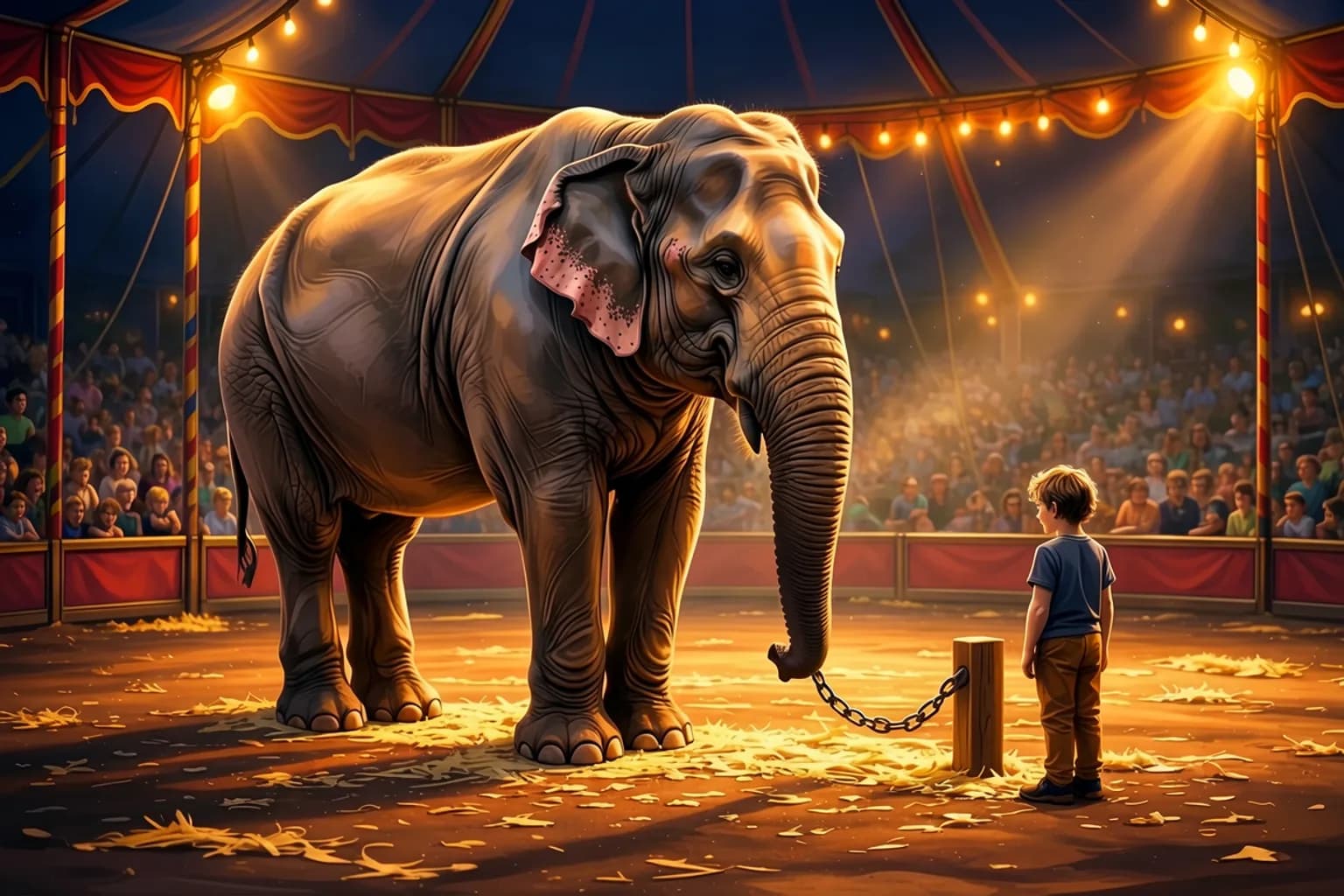
A boy at the circus stood looking at the elephant for a long time, longer than at anything else, and what he could not get past was the stake.
The animal was enormous. It could lean on a truck. It lifted things that took six men. And it was held in place by a light chain running from one ankle to a short wooden peg pushed into the ground, the kind of peg you could pull out with one hand.
He asked the adults why the elephant did not simply walk away.
They gave him the answers adults give. Because it is tame. Because it is trained. Because it is used to it. None of which explained anything, and he knew it, and he asked again and got the same answers with more impatience in them.
Years later somebody told him the actual reason.
The elephant does not leave because it cannot leave. It cannot leave because when it was very small, days old, they put that same chain on that same ankle and drove the peg into the ground, and at that size the peg was immovable.
It pulled. It pulled every day, with everything it had, and every day the ground held, and then one day it stopped pulling.
It did not stop because it was broken. It stopped because it had run the experiment enough times to have an answer, and the answer was consistent, and any creature that keeps testing a settled question is wasting energy it needs for other things. Concluding is what intelligence does.
The animal is now four tonnes. The peg has not changed. Everything else has. And the last real information it has about that chain is thirty years old and was collected by a body that no longer exists.
It is not held by the stake. It is held by a result.
The Lesson of the Chained Elephant
Your limits are dated. Most of the things you know you are not capable of were established at a particular moment, by a particular version of you, with the resources you had then. The finding may have been perfectly sound and it is still thirty years old.
Not trying is a conclusion, not a personality. It feels like a fact about who you are. It is the residue of an experiment. That distinction is the entire content of the story, and it matters because facts about who you are cannot be revisited and old results can.
Test the small things first. Nobody wakes up and pulls the peg. But there is usually something you last attempted at nineteen and have quietly filed as impossible, and finding out costs an afternoon.
Where this actually comes from
There is no ancient source for this one. It is modern, and it is usually presented without any source at all.
The version that spread through the English speaking world is most often traced to the Argentine psychotherapist Jorge Bucay, who published it in Spanish in the 1990s in a collection of teaching stories, told as a memory of his own childhood at the circus. It was picked up by motivational speakers everywhere in the decade that followed and is now told as if it were a folk tale.
The mechanism it describes is real, which sets it apart from most stories of this kind. Young elephants genuinely were and in some places still are picketed by one leg, and the intended effect is exactly the one in the story, and it works.
That is also the part worth being honest about. What the parable describes as a charming quirk of animal psychology is a training practice, done deliberately, to an infant, in order to produce an adult that will not resist. The elephant is not making an interesting cognitive error. It is the product of something that was done to it.
Which does not weaken the lesson so much as sharpen it. Most people did not arrive at their limits by reasoning badly on their own either. Somebody put the chain on.