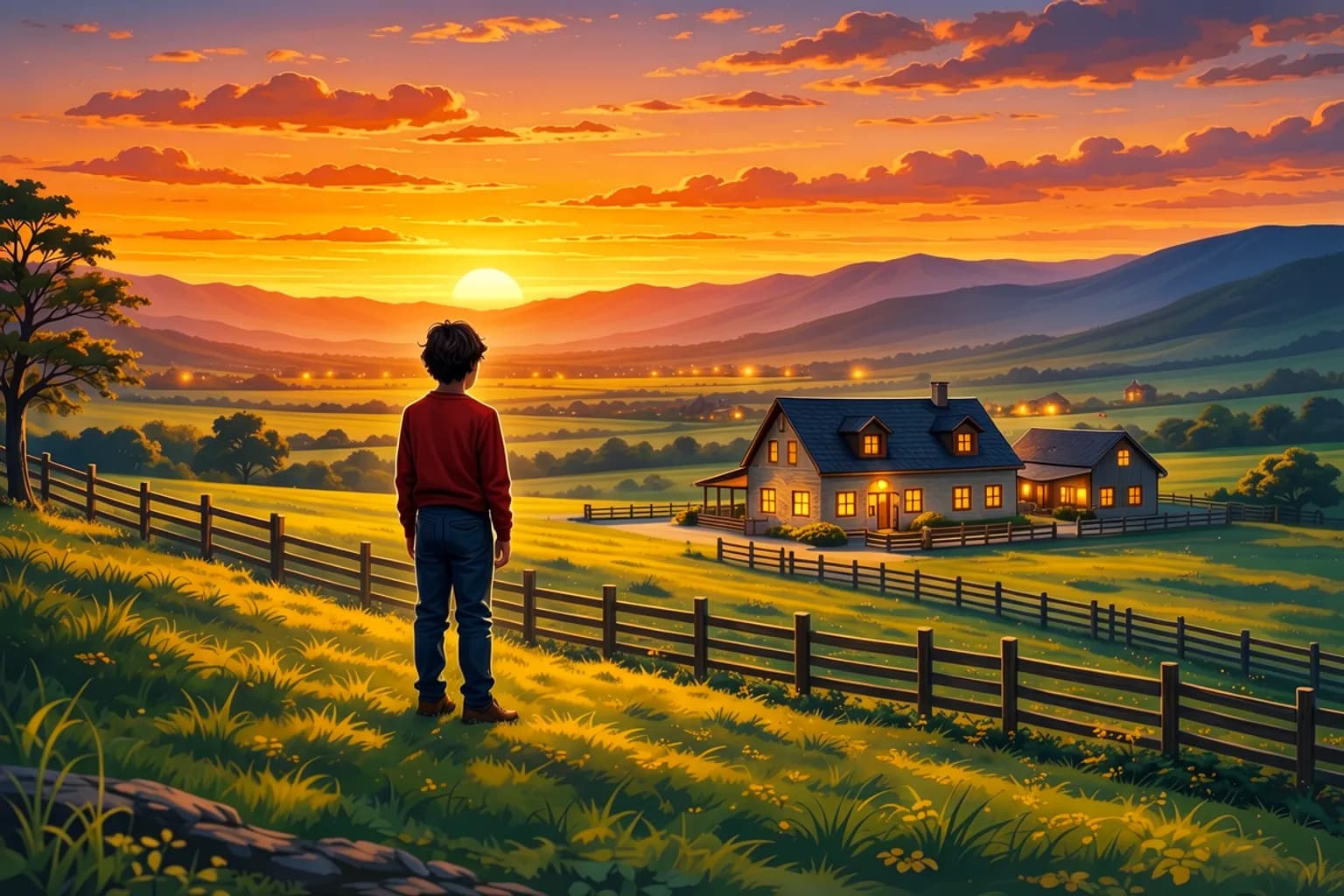
The boy's work started before light and finished after dark, and the only hour that belonged to him was the one at the end of the afternoon when the animals were in and nothing else was owed.
He spent that hour on the hill behind his father's farm, looking across the valley at the house with the golden windows.
It stood on the far slope. Every evening, as the sun dropped, its windows caught fire and burned gold, all of them at once, and it was the most beautiful thing in the world. He was certain about the people in it. They did not get up in the dark. They had windows made of gold, and whatever kind of life produced windows like that was not the kind he had.
He asked, and he saved, and eventually his father said he could go, if the work was done and he was back before night.
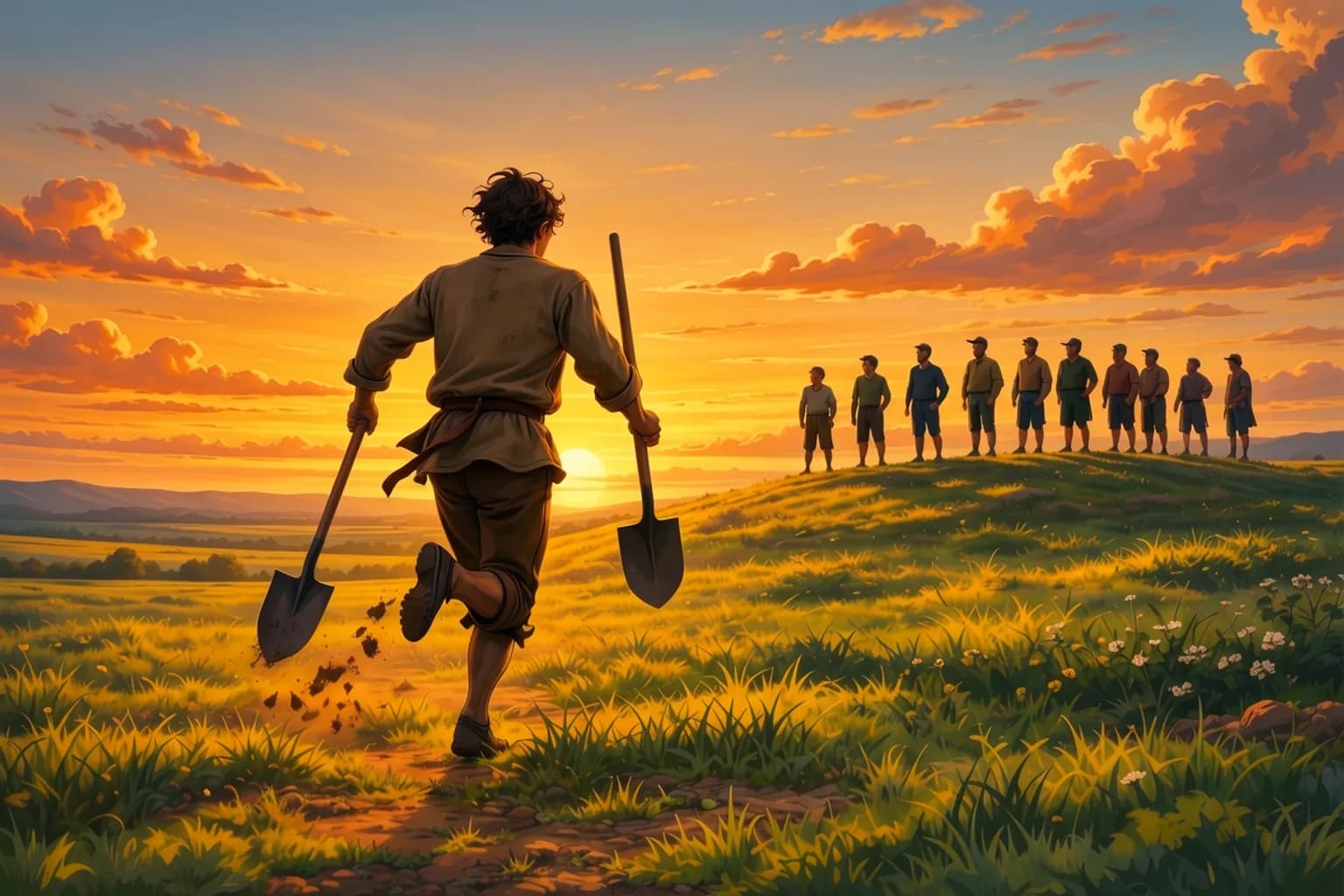
So he went. Down through the fields and across the stream, and up the far slope, and it took most of the afternoon and it was further than it had looked, as it always is.
He came over the last rise and found a farmhouse. Small, plain, a little worn. Ordinary glass in every window, and nothing gold about any of it.
A girl about his own age was sitting on the step, and he was too disappointed to be polite about it. He asked where the house with the golden windows was.
She said she knew that house. She had been watching it for years.
She stood up and pointed back the way he had come, across the valley, to the far slope, where the sun was now going down behind him and one small farm on the hillside had every window burning gold.
He walked home in the dark. He got in late and got into trouble for it. And from that evening on, at the end of the afternoon, he was the boy on the hill who knew that a girl on the other side was looking at his windows.
The Lesson of the Golden Windows
Distance is doing most of the work. He was not wrong about what he saw. The windows really were gold. He was wrong about what it meant, and the error was not in his eyes, it was in the mile between him and the glass.
You are somebody's golden windows right now. Not as a comfort and not as a reason to feel guilty. As a fact about angles. Somebody is currently describing your life to themselves in a way you would not recognise.
The walk is still worth taking. He did not lose anything by going. He lost an illusion, met a girl who had the same one, and came back able to see his own house. Envy answered from a distance stays alive forever. Envy walked all the way up to usually dies on the doorstep.
Where this actually comes from
This one circulates as an anonymous folk tale, often labelled as an old European story or as something a grandmother used to tell, and it is neither.
It has an author and a date. Laura E. Richards, an American writer best known for children's books and for a biography of her mother, published it in 1903 in a collection whose title story it was. She wrote a great deal of this kind of short moral piece, and this is the one that got away from her and became public property.
It is out of copyright now, which is part of why it travels so freely and why so few of the versions online carry her name.
Her original is quieter than most retellings. There is no lesson delivered at the end, no line about being grateful for what you have, and no adult explaining anything to the boy. He simply walks home, and Richards leaves him with it, which is the better version and the reason it survived long enough for everyone to forget who wrote it.