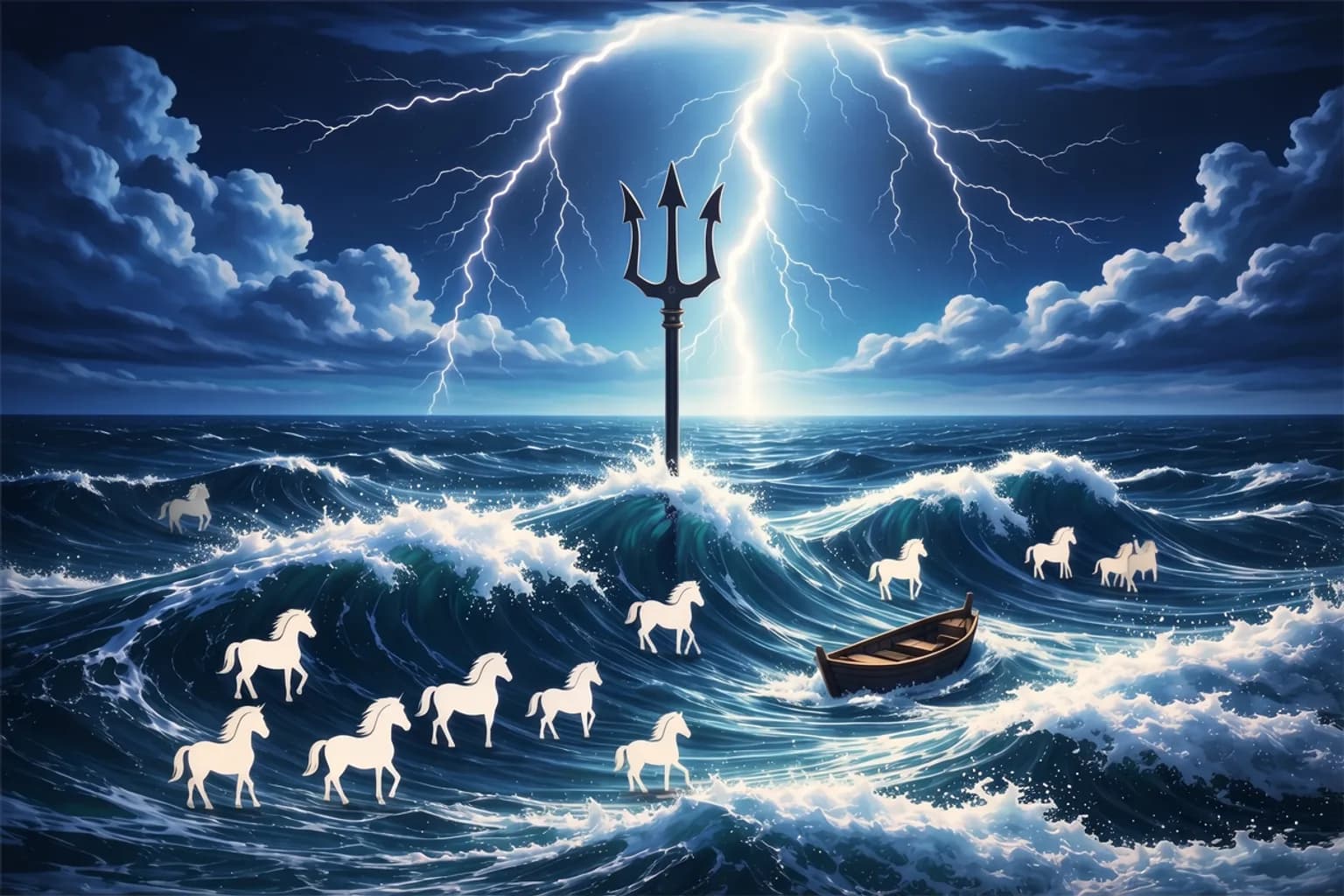
A civilisation of sailors will know exactly one thing for certain about the sea: it does not negotiate. The Greeks, who lived and died by water, distilled that knowledge into Poseidon: middle brother of the ruling three, lord of the sea, the earthquake, and the horse, a portfolio that reads at first like a junk drawer and is actually a single phenomenon, the powers that move beneath you without consent.
Of the great Olympians, he is the least philosophical and the most meteorological: less a mind to persuade than a weather system with a memory.
The Portfolio of Moving Ground
- The sea: highway and graveyard at once for every Greek family; his mood was the day's itinerary
- The earthquake: the earth-shaker, his oldest title; the Greeks placed the sea god under the land too, where the deep water tables churned, and the intuition was geologically shrewder than they knew
- The horse: wave-maned and earth-drumming, his gift or creation in the myths; power that can be bridled but never quite owned
- The trident: the three-pronged fish spear raised to cosmic instrument; he strikes the acropolis rock with it and produces, characteristically, a spring of salt water, magnificent and undrinkable
Poseidon's gift to Athens was salt water; Athena's was the olive. The city chose the useful over the sublime, and the sea god flooded the plain to register his review.
The Grudge as Plot Engine
His defining trait in the literature is the long, patient grudge. The entire Odyssey runs on it: Odysseus blinds the Cyclops Polyphemus, Poseidon's son, and the sea god spends ten years returning the favour, wave by wave. He cannot kill the hero, fate forbids it, so he does what the sea does: delays, exhausts, detours, and drowns the crew. The Greeks understood their sea precisely: rarely malicious, never forgetful, and entirely capable of holding a course against you for a decade.
The shadows are recorded with the tradition's usual honesty, his pursuit of Demeter and the violence in Medusa's story among them; the sea's amorality, the myths insist, extends all the way down.
The Story Behind the Stories
Historically, Poseidon is among the oldest attested Greek gods, his name appearing on Mycenaean Linear B tablets, where at Pylos he, not Zeus, seems the chief deity, the sky king's seniority being a later election. The horse association likely rode in with Indo-European steppe inheritance; the great sanctuaries at Isthmia and Sounion, that white-columned cape every Athens-bound traveller still photographs at sunset, kept his cult where sailors could see it, and offerings went over the side accordingly. Rome merged him with Neptune, handing his trident to every fountain in Europe.
What Poseidon Teaches
That the forces beneath a life, economies, health, the literal ground, do not answer to merit and must be respected rather than presumed upon, a seamanship of existence every coastal grandmother teaches in some dialect. And that grudges, his specialty, behave exactly like his element: vast momentum, no brakes, and ruinous mostly to whoever must keep sailing through them, a finding my colleague Sarah's column on anger reached by dry land.