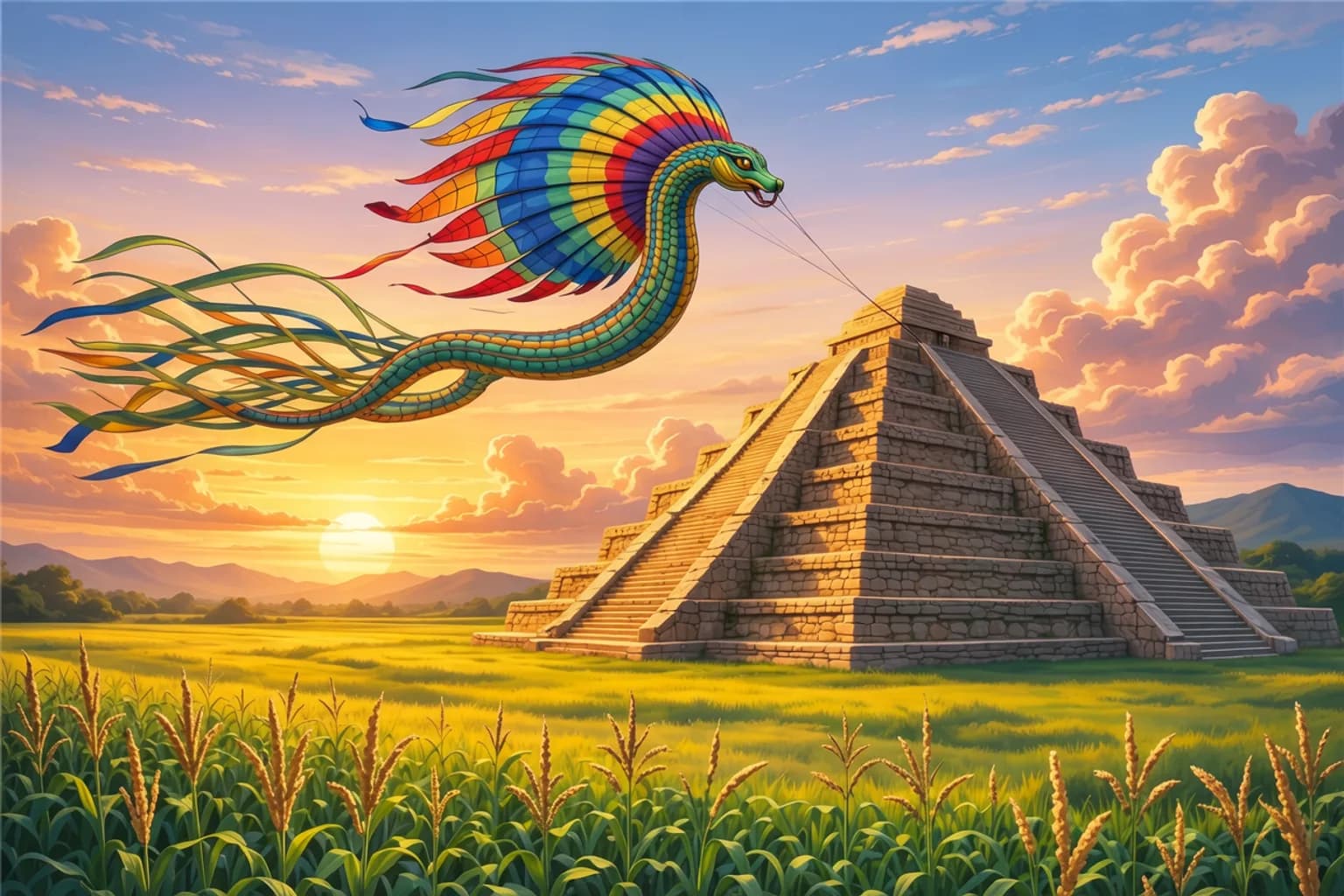
The name is a fusion and so is the god: quetzal, the emerald bird whose tail feathers were worth more than gold in old Mesoamerica, and coatl, serpent. The feathered serpent: the creature of the ground given the sky, earth and air in one body, and for some three thousand years, under several names and across many peoples, the symbol of exactly that crossing, matter learning to fly.
Of all the deities this series has profiled, none carries a stranger or sadder afterlife in the world's imagination, and his real file deserves better than the legends about him.
The Civiliser
In the Aztec accounts and their predecessors, Quetzalcoatl's portfolio is civilisation itself:
- Maize: in the great telling, he transforms into an ant to steal the first kernels from the mountain where they were hidden, and gives them to humanity; bread, in Mesoamerica's accounting, was burgled for us by a god small enough to care
- The calendar, writing, and learning: the priestly arts and the craftsman's, his gifts; his priests bore his name as a title, scholarship as a form of his worship
- The wind: as Ehecatl, he sweeps the roads before the rains; his temples alone were round, so the wind would find no corners to fight
- The creation of this humanity: in the age before ours, the myth says, he descended to the underworld, gathered the bones of the previous people, bled on them from his own body, and made us; we are, in that account, the serpent's transfusion
- The refusal: in the Toltec memory, his city of Tula sacrificed butterflies and serpents, not men; the god of civilisation, the old sources insist, declined human blood, a position that set him against the entire later machinery of the sacrificial state
Quetzalcoatl's myth keeps civilisation's real inventory: grain, calendars, letters, wind-swept roads, and the refusal of cruelty, listed as one god's luggage.
The Fall and the Promise
The tradition gave its best god a tragedy. His rival Tezcatlipoca, the smoking mirror, brings him a mirror of his own and, in the famous telling, shows the pure priest-king his aging human face, then plies him with pulque until, drunk, he fails his own standards. In the morning, the shame is unanswerable, and Quetzalcoatl burns his turquoise house, buries his treasures, and walks east to the sea, where he departs on a raft of serpents, or burns and becomes the morning star, promising, in some tellings, to return in a One Reed year.
The story everyone has heard next, that Moctezuma mistook Cortes for the returning god in the One Reed year 1519, is, the historians' consensus now holds, largely post-conquest construction, a narrative assembled afterward by parties with motives. The feathered serpent deserves the correction: his myth was about a god undone by being shown his own face, not a people undone by mistaking a face for a god's.
The Story Behind the Stories
Historically, the feathered serpent is among the Americas' oldest continuous religious images: carved at Teotihuacan's great temple by the third century, central at Toltec Tula, Maya Chichen Itza as Kukulkan, where the equinox sun still casts a serpent of shadow down the pyramid steps for crowds every spring, and finally in the Aztec capital, where his round wind-temples stood beside the great sacrificial precinct in permanent silent argument. The historical Toltec priest-king Ce Acatl Topiltzin Quetzalcoatl, whose biography tangles with the god's, remains the region's Arthur: real, probably; legendary, certainly; separable, never.
What Quetzalcoatl Teaches
That civilisation is a gift list, and the list is humble: grain, letters, calendars, swept roads, the things my colleague Naomi's columns would call infrastructure and this one calls luggage. That the highest religious idea the region produced, the refusal of cruelty as worship, predated its conquerors' arrival and owed them nothing. And that the serpent given feathers remains the truest emblem of the whole human project this series has met in any hemisphere: the ground-dweller, by patience and gift-giving, learning flight, and the mirror, as ever, the most dangerous object in the story.