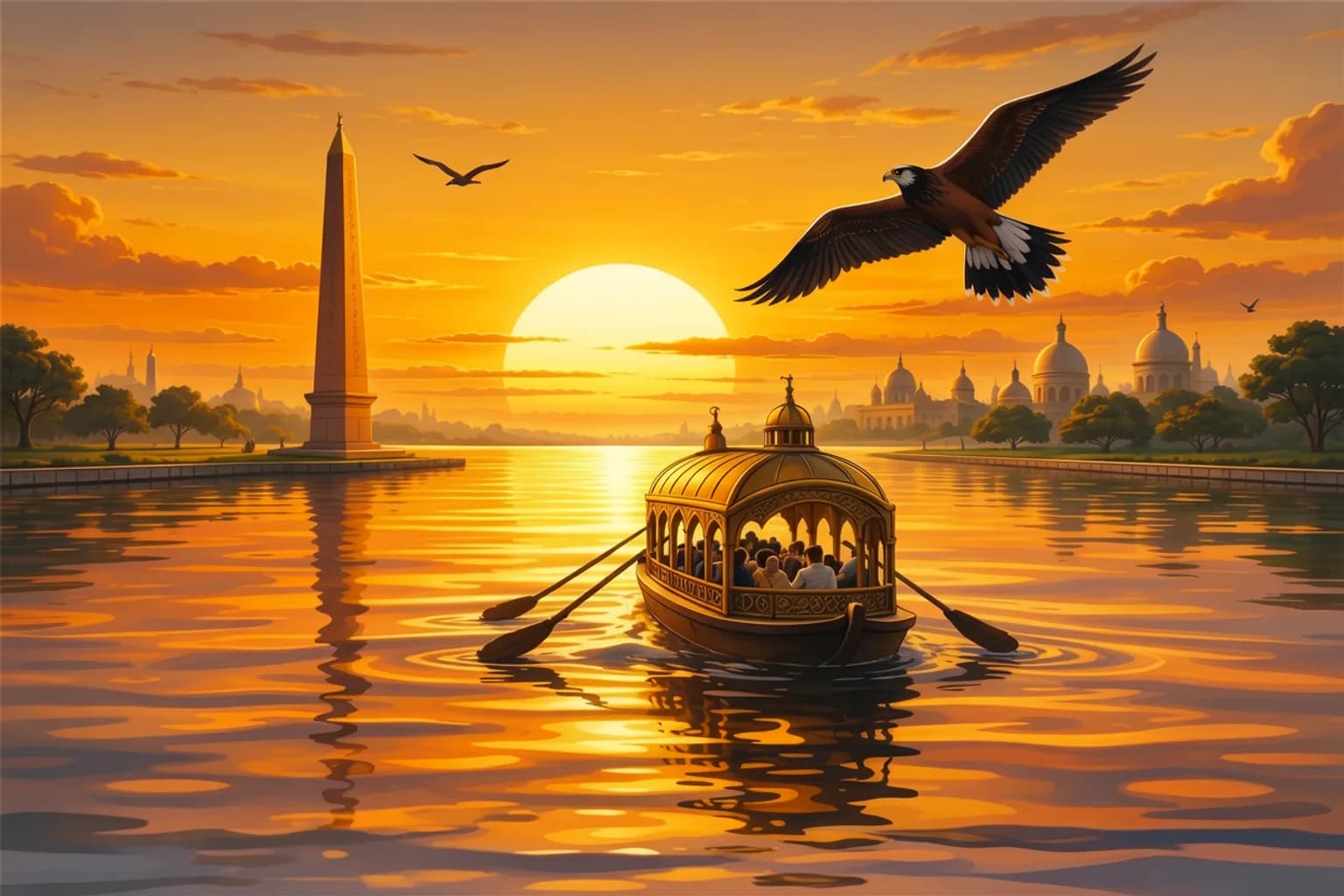
Stand in the Egyptian desert at dawn, as I once did outside Luxor with a thermos and inadequate sleep, and the old theology explains itself without a guidebook: in that country, the sun is not a feature of the sky. It is the entire question. Egypt's answer was Ra: falcon-headed, crowned with the solar disk, the daylight not as object but as person, sailing his barge across heaven from horizon to horizon, every single day, on time, for three thousand recorded years.
But the day-voyage was never the heart of it. The heart of it was the night.
The Voyage Below
At sunset, the Egyptians held, Ra's barge does not dock. It descends into the Duat, the underworld, and sails the twelve hours of the night through territory that wants the sun never to rise again. Each hour has its gates, its guardians, its dangers, and at the deepest hour waits Apophis, the chaos-serpent, coiled to swallow the light itself. The crew fights; the great gods take their shifts at the prow; even Set, elsewhere the villain, spears the serpent in this telling, chaos useful against deeper chaos. And at dawn, the sun rises not because it was never threatened, but because the threat was met, again, at the worst hour, in the dark.
- The scarab: Ra at dawn as Khepri, the beetle rolling the sun like dung-ball into being, rebirth from the least promising material in the desert
- The disk and falcon: Ra at noon, height and sight, the unanswerable fact of midday
- The ram-headed evening form: the sun aged by its own day, entering the dark already tired
- The serpent, every night: the adversary never finally killed, only nightly defeated; Egypt's bracing honesty about how order actually persists
Egypt's sun did not rise by default. It rose because, in the doctrine's plain arithmetic, the fight at the bottom of the night was won again, and the winning was never permanent, only daily.
The Pharaoh's Engine
Historically, Ra was state theology at the highest voltage: Son of Ra entered the royal titulary by the Fourth Dynasty, the pyramid age built its geometry around his Heliopolis cult, and later syncretism fused him with Thebes' rising god as Amun-Ra, king of the gods, the merger every Egyptian power shift required. One pharaoh, Akhenaten, pushed solar devotion into something like monotheism of the disk itself, and the establishment's furious erasure of that experiment afterward is its own lesson in how seriously the older arrangement was held. Through all of it, the barge sailed: dynasties were temporary, the voyage was not.
What Ra Teaches
That renewal is not a mood but a discipline with a night shift: the dawn my colleague Dev's grandfather greeted with the Gayatri, the daily rising my colleague Arjun builds from a notebook and a cushion, Egypt drew as an armed barge in the dark, and all three are the same doctrine at different latitudes. That chaos is never finally defeated, only nightly, which excuses no one from the spear. And that the oldest civilisation on the river bet its entire cosmology on one claim, verified now roughly a million mornings running: the worst hour of the night is an hour the light has survived before.