Among the goddesses of the Hindu world, Lakshmi glitters and Durga blazes, and then there is Saraswati: dressed in plain white, seated on a white lotus, holding not weapons or coins but a veena, a book, and a string of beads. She is knowledge itself, learning, music, eloquence, the arts, and every student in India has, at some point, prayed to her the night before an examination, including several who told me so in perfect, Saraswati-blessed English.
The Iconography of Learning
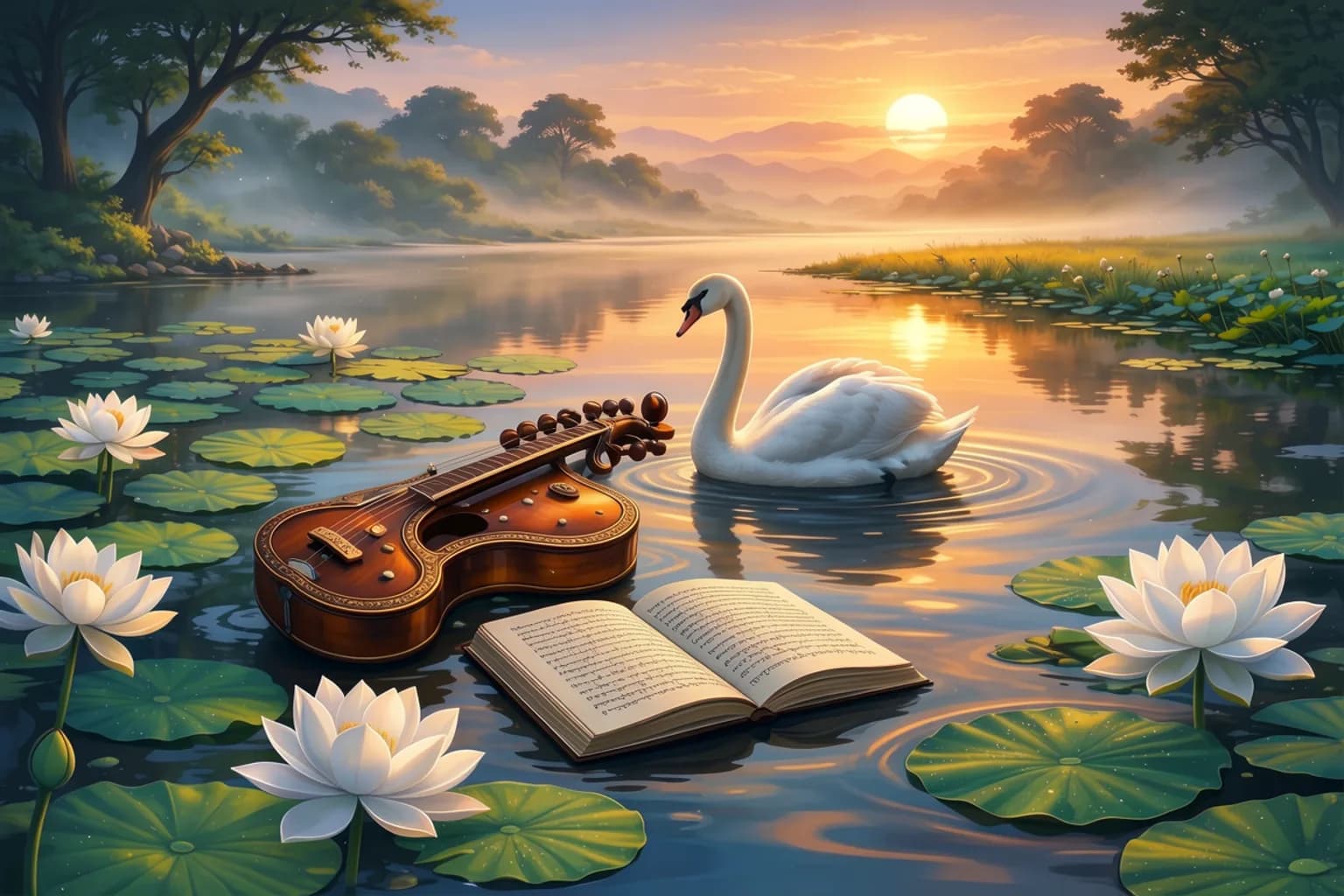
Her image is a complete philosophy of education, item by item:
- The white garments: knowledge unadorned; truth needs no gilding
- The veena: learning as music, knowledge that must be practised daily or it goes out of tune
- The book: the scriptures and all books after them; memory outsourced to ink so the mind can climb higher
- The beads: repetition, the unfashionable secret of all mastery
- The swan: the famous discriminator, said to drink only the milk from a mixture of milk and water; the educated mind's one essential skill, separating truth from dilution
- The flowing river beneath her name: she began as a literal river, and learning kept the river's nature, always moving, never owned
Saraswati's swan is the entire curriculum: anyone can swallow a mixture. Education is learning to take the milk and leave the water.
The Rivalry With Fortune
The folk tradition delights in the tension between Saraswati and Lakshmi, knowledge and wealth, and tells it with a wink: the two goddesses rarely dwell long in the same house. The scholar's home is poor; the merchant's library is thin. Families hedge by honouring both and observing, ruefully, which one accepted the invitation. Beneath the joke sits a real teaching about divided devotion: both goddesses reward singleness of pursuit, and each notices when she is courted merely as a means to the other.
My own grandfather in Beirut, a souk trader who read history at night, kept what I now recognise as a two-goddess household: ledger on one shelf, books on the other, and a strict rule that neither shelf borrow from the other's lamp oil.
The Story Behind the Stories
Historically, Saraswati is among the most ancient figures in the tradition, older as a name than almost any deity still worshipped: she enters the record in the Rig Veda as a mighty river, praised as mother of waters, and as the rivers shifted over centuries, scholars trace the goddess's migration from water to word, the flowing river becoming flowing speech, then knowledge entire. Her spring festival, Vasant Panchami, still sees children taught their first letters, instruments placed before her image, and the colour yellow flooding northern India like early mustard bloom.
She travelled, too, as learning does: into Buddhism, and east with it, where Japan still venerates her as Benzaiten, goddess of music and eloquence, shrine islands and all. A Vedic river goddess, worshipped today in Tokyo: knowledge keeps the river's habit of crossing borders.
What Saraswati Teaches
That learning is a devotion, not a transaction: practised daily like the veena, strung on repetition like the beads. That its dress is plain because its wealth is internal, and famously uneasy with the other kind. And that the mind's highest skill is the swan's: discrimination, the quiet daily separation of milk from water, signal from noise, truth from its dilutions. In a century drowning in mixture, I can think of no older goddess with a more current portfolio.