This series profiles gods, and so it owes the reader a correction before this entry begins: the Buddha is not one, and was asked, and said so. The accounts preserve the exchange. Pressed on what he was, a god, a spirit, something else, he answered only: I am awake. The title Buddha means exactly that, the awakened one, and the tradition built on him has spent twenty-five centuries managing the world's persistent urge to promote him anyway.
He earns his place in this column as the most consequential single biography the spiritual world possesses: a man, locatable in history, who sat down under a tree with a problem and stood up with a curriculum.
The Biography
Siddhartha Gautama was born a prince of the Shakya clan, in the borderlands of today's Nepal, most scholars now placing him in the fifth century before our era. The story's famous architecture: a father who walled the palace against all evidence of suffering; the four sights that breached it, an old man, a sick man, a corpse, and a wandering ascetic; and the departure at twenty-nine, leaving wife, son, and succession at night, to solve the problem the palace had been built to hide.
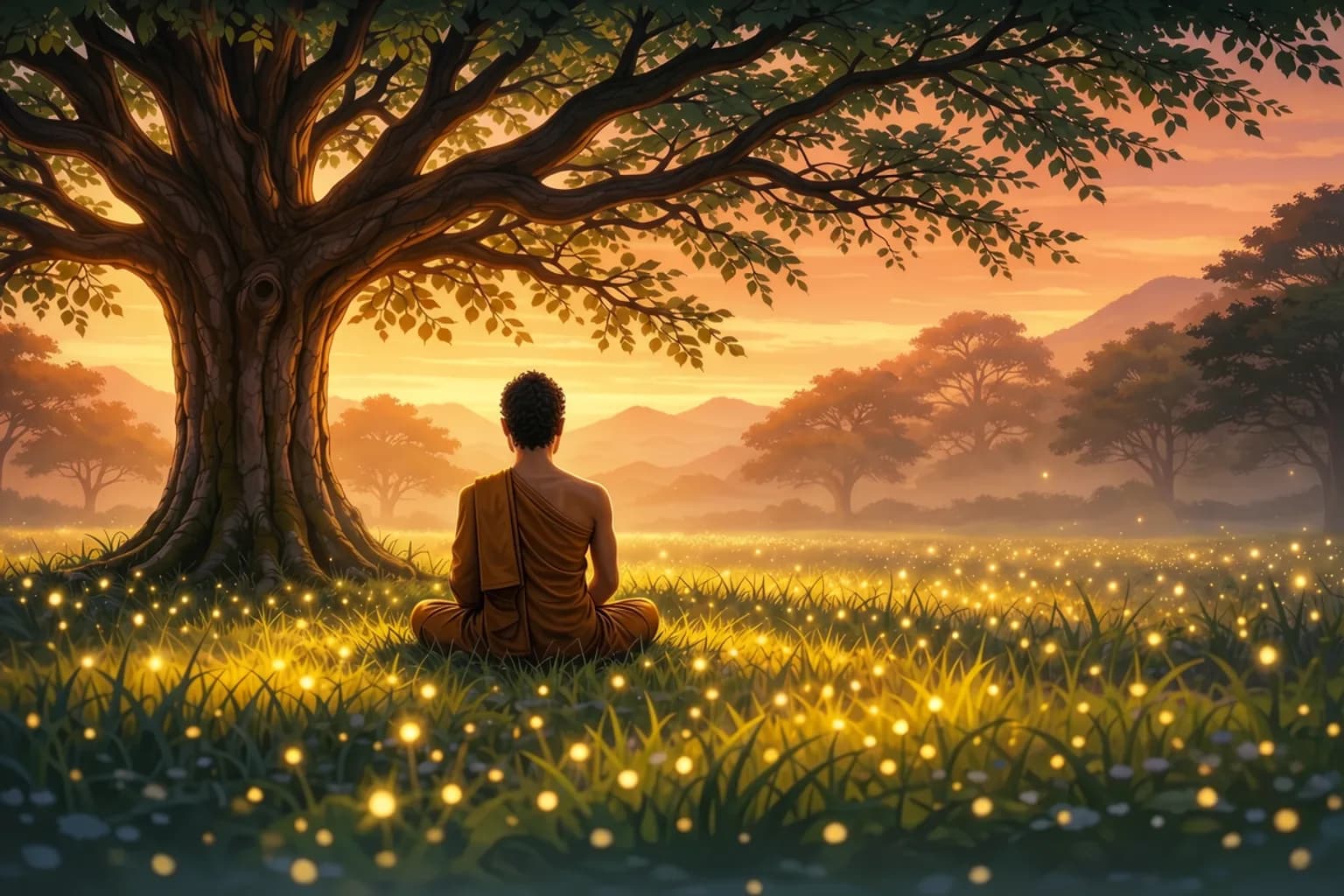
Six years of the era's harshest asceticism followed, starvation included, until he concluded that mortifying the body answered nothing, accepted a bowl of milk-rice, and sat beneath a fig tree at Bodh Gaya with a vow not to rise. The accounts give the night its drama, the tempter Mara, the armies, the beautiful daughters, the final demand that he prove his right to the seat, answered by the most famous gesture in Asian art: one hand touching the ground, the earth itself as witness. What rose at dawn taught for forty-five years, walking the Gangetic plain, and died at eighty, of bad food accepted graciously, with a last instruction worth more than most scriptures: all conditioned things pass; work out your liberation with diligence.
- The Four Noble Truths: suffering exists; it has a cause, craving; it has an end; the end has a path
- The Middle Way: between the palace and the starvation, the road that actually walks
- The Eightfold Path: seeing, intending, speaking, acting, working, striving, attending, and concentrating, rightly; a curriculum, not a creed
- Anatta and impermanence: no fixed self to defend, nothing that stays; my colleague Arjun's columns on watching the mind descend directly from this analysis
The Buddha's claim was the most modest and most radical on record: not that he was divine, but that he was awake, and that the seat under the tree was not reserved.
The Story Behind the Stories
Historically, the man wrote nothing; the teachings travelled four centuries by trained memory before Sri Lankan monks committed them to palm leaves. The emperor Ashoka, sickened by his own conquests two centuries after the Buddha's death, turned the teaching into history's first missionary religion, his edicts still standing in rock across the subcontinent; the dharma walked the Silk Road east to China, Korea, Japan, south to Burma and Siam, taking new forms at every border with a flexibility its founder would likely have approved, having compared his own teaching to a raft: for crossing, not for carrying on the head afterward. And the urge to deify proved unstoppable anyway: across Asia he is worshipped in all but name, and in Hindu tradition absorbed as an avatar of Vishnu, my colleague's column on whom describes the embrace. The man who said I am awake became, ironically and inevitably, the most serene face in the world's iconography.
What the Buddha Teaches
The tradition would correct the question: not what he teaches, but what can be verified on the cushion, since he insisted, in the Kalama discourse, that even his own words be tested like gold and not taken on reverence. But this column permits itself one historian's observation. Of every figure profiled in this series, across six pantheons, the one with no thunderbolt, no army, no miracle but attention, the one who only sat down, travelled the farthest, and is sitting still, in storefronts and forest monasteries and apartment corners on every continent, wherever someone, this morning, took the unreserved seat.