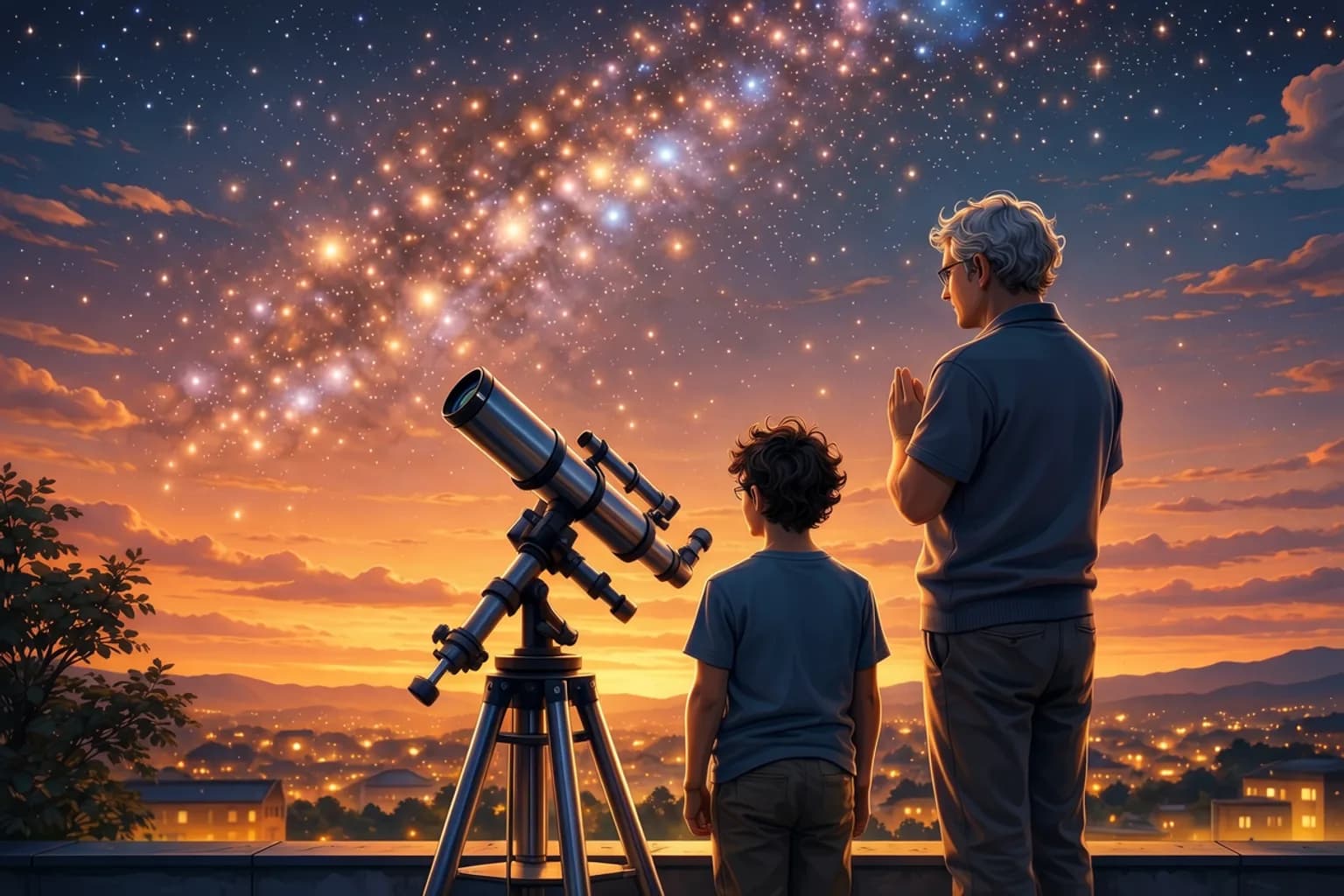
For a long time it was assumed that science and faith were locked in a war that science was winning. Each new discovery, the story went, pushed the divine further out of the picture, until eventually there would be no room left for it at all. But something interesting has happened as our knowledge has deepened. The more clearly we see the universe, the stranger and more astonishing it becomes, and the harder it is to dismiss the ancient intuition that something profound underlies it all.
This is not an argument that science proves God; that would overstate the case in both directions. It is an observation that the deepest findings of modern inquiry keep brushing up against the same questions the great traditions have always asked.
Physics was my first love, and it never left me. What changed is what the equations did to me: the deeper I went, the more the universe looked less like furniture and more like a thought. My grandfather, who never studied science, used to say the same thing in his own words while looking at the night sky from our rooftop in Varanasi. They were closer than either vocabulary suggested.
The Astonishing Order
The universe did not have to be comprehensible. It did not have to run on elegant mathematical laws that a human mind could discover. And yet it does. The physical constants that govern reality are tuned with a precision so extraordinary that small changes in any of them would have produced a universe with no stars, no chemistry, no life, and no one to notice.
That the universe is ordered, lawful, and intelligible at all is a fact so easily taken for granted that we forget how astonishing it is.
Scientists describe this fine-tuning in careful, neutral language, but the wonder underneath it is hard to miss. The deep order of things does not by itself prove a designer, but it makes the universe look far less like an accident than the confident materialism of a century ago assumed.
The Mystery of Consciousness
Then there is consciousness, the most familiar thing in the world and the most baffling to science. We can map the brain in extraordinary detail, but no one can explain how physical matter gives rise to inner experience, to the felt sense of being someone, here, now. The very thing through which you experience everything remains, scientifically, a profound mystery.
The traditions have always placed consciousness near the center of reality rather than at its edge. Modern inquiry, having assumed it would explain consciousness away as a mere byproduct, finds itself unable to do so, and a growing number of serious thinkers wonder whether awareness is more fundamental than the old picture allowed.
Where Wonder Leads
Several frontiers keep returning us to the ancient questions:
- The fine-tuning of the cosmos for the existence of life.
- The deep, elegant intelligibility of physical law.
- The unexplained leap from matter to conscious experience.
- The strange role of the observer in the foundations of physics.
None of these is a proof. But together they have humbled the confident certainty that the universe is merely a meaningless machine. The honest scientific posture before these mysteries is not dismissal but wonder, and wonder has always been the doorway to the sacred.
Faith and Inquiry as Companions
The deepest scientists have often been the most reverent, precisely because they saw most clearly how astonishing existence is. Far from killing faith, a genuine encounter with the depth and order of reality tends to reawaken it, not as dogma, but as awe before something vast and intelligible and strange.
Science and faith need not be enemies. At their best, both are forms of attention to the same astonishing reality: one measuring it, the other revering it. And the more carefully we measure, the more there seems to be to revere. The universe keeps turning out to be deeper than we expected, and the oldest questions, the ones about meaning, mind, and source, refuse to go away.