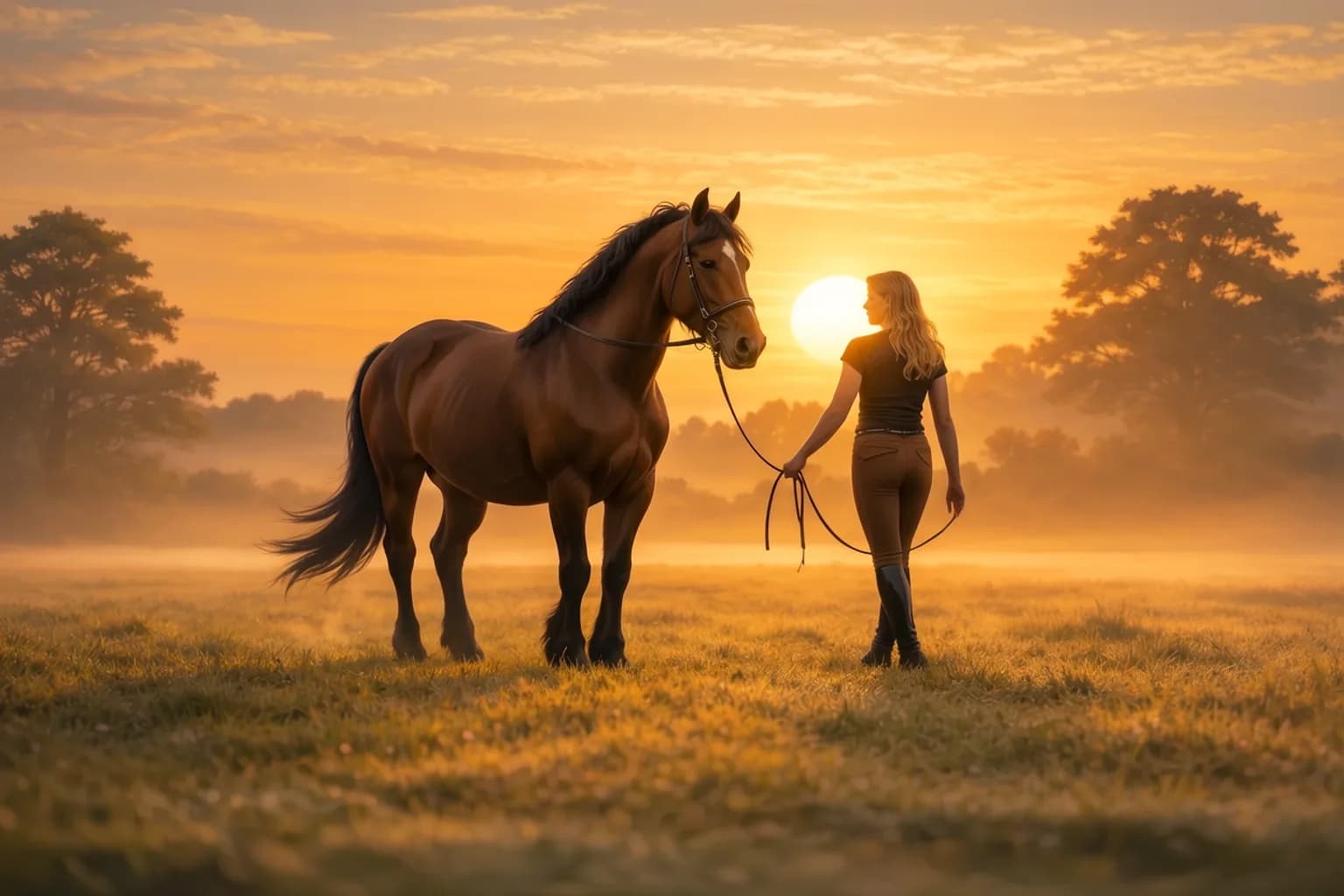
An old farmer kept one horse. In that village, on that land, a horse was the difference between a season that fed you and a season that did not.
One morning the horse was gone. The gate stood open and the field was empty. The neighbours came, as neighbours do, and stood at his fence and told him how sorry they were. Terrible luck, they said. The worst thing that could have happened.
"Maybe," the farmer said.
A week later the horse came back down out of the hills, and it brought three wild horses with it, and they followed it through the open gate and into his field. The neighbours came again and looked at four horses where there had been none. Wonderful luck, they said. You are a rich man now.
"Maybe," the farmer said.
His son began breaking the wild horses. He was young and good at it and he enjoyed being watched. One of them threw him against a wall and his leg broke in two places and healed badly. The neighbours came and stood by the fence and said it was a tragedy, a young man crippled, and just when things had turned.
"Maybe," the farmer said.
He was not being wise at them. He simply had not been given enough of the story to have an opinion yet.
That autumn the army came through, conscripting every young man who could walk, for a war on the border that most of them did not come home from. They looked at the son's leg and moved on to the next house. The neighbours, whose sons were gone, came to the fence and said how fortunate he was.
"Maybe," the farmer said.
The Lesson of the Farmer Who Said Maybe
Most verdicts are delivered too early. The neighbours were not stupid. Each judgement was reasonable given what they could see. They were simply certain at four separate moments, and wrong at all four.
"Maybe" is not passivity. The farmer still fed the horses, still called the doctor, still ran the farm. He withheld the verdict, not the effort. Refusing to label an event is different from refusing to act on it.
The story does not end where your feelings peak. Grief and triumph both arrive with a strong sense of finality. That feeling is not evidence. It is just the nervous system reacting to the newest fact.
Where this actually comes from
This is usually presented as a Zen story, and it is not. It is Taoist, and it is considerably older than Zen. The earliest version appears in the Huainanzi, a Chinese text compiled around 139 BCE under the patronage of Liu An, king of Huainan. In Chinese it is remembered by a proverb rather than a title: sāi wēng shī mǎ, the old man of the frontier lost his horse, still used today to mean that a setback may not be one.
The English-speaking world largely met it through Alan Watts in the mid twentieth century, and his retelling is the reason it now circulates with a Zen label attached.
The older text is also blunter than the version we tell. It is not really offering comfort. It is making a harder claim: that fortune and misfortune produce each other continuously, and that human beings are simply not positioned to see far enough along the chain to judge where they are standing.